

Macron Breaks Silence on France Riots: ‘Anger and Shame’ After 2,400 Arrests
Paris — Two days after France convulsed through its worst night of street violence in years, Emmanuel Macron finally faced the cameras. The French president’s Sunday evening national address on the France riots was part confession, part warning — an attempt to speak to a furious country in a moment that feels bigger than any single protest day.
“Looking at these images, we have all asked ourselves: what was going through their minds? How can French people do this to France?” Macron said, in a televised address from the Élysée Palace. Then the line that will likely define this week: “Nothing justifies it, nothing explains it, nothing excuses it. Tonight, we all feel anger and shame.”
It was a striking performance from a president in the final stretch of his power — Macron leaves office in 2027 after a decade defined increasingly by social unrest. But anger and shame are easy emotions to share. The harder question — the one France will be asking all week — is whether the country heard anything new in what he said. Let’s look at what the address actually contained, what happened on Sunday after it, and why this crisis is far from over.
What Macron announced — and what he didn’t
The Macron France riots address walked a deliberately fine line. On one side, the president drew a bright boundary between what he called the “legitimate demands” of peaceful protesters and “those who destroyed, smashed and looted.” On the other, he made a striking admission: young people, he said, are expressing a “deep anguish and concern about the future” — about study conditions, about finding a place in society, about “the idea that there would be no desirable future.”
That was the softer Macron: “their voices must be heard without preconceived ideas,” he said, promising that “difficulties must not be minimized.” It was a notable acknowledgment that the movement’s roots — student blockades of lycées over crumbling schools that began back in mid-September — contain something real, not just pretext for violence.
Then came the hard edge. Macron vowed that looters would “have to pay for the damage” and that anyone who sought to “overthrow the Republic” would be held accountable. He stopped short of declaring a state of emergency, as some right-wing politicians had demanded — but said the government would take steps to allow prefects to ban protests when necessary to protect public buildings and local businesses.
Prime Minister Sébastien Lecornu, meanwhile, has been tasked with convening political parties and trade unions — a classic French ritual of post-crisis dialogue that will be judged entirely on whether it produces anything concrete.
Sunday after the storm: Paris still crackles
Macron’s address was supposed to close the weekend. Instead, Sunday showed why this story isn’t ending. As the president spoke of calm and order, clashes continued on a smaller scale in Paris and Lyon. According to AFP, tear gas and stun grenades were fired at hundreds of people near the Place de la République, where protesters tried to erect barricades — and bottles and rocks were thrown back at police.

The weekend’s toll is staggering. France’s Interior Ministry reported roughly 2,400 arrests nationwide — 855 of them in Paris alone, according to the Associated Press. Interior Minister Laurent Nuñez said nearly 1,000 police officers and gendarmes were injured on Saturday, seven of them seriously. And in a detail that deepens the tragedy, one protester died after suffering a cardiac arrest during demonstrations in Paris on Saturday.
The single most shocking image of the weekend remains the one from Limoges: the 143-year-old town hall, its 19th-century clock tower and roof collapsing into flames after masked rioters broke in and set it alight. As we reported from Limoges, local officials called the destruction of the historic monument “largely lost” — a catastrophe for heritage that has become the symbol of how far this weekend went.
“France is burning!” — and the world is watching
The France riots have now become international news, and the reactions are telling. On Sunday, US President Donald Trump declared on social media: “France is burning!” It was blunt, gleeful even — and it guaranteed the story would dominate a second news cycle.
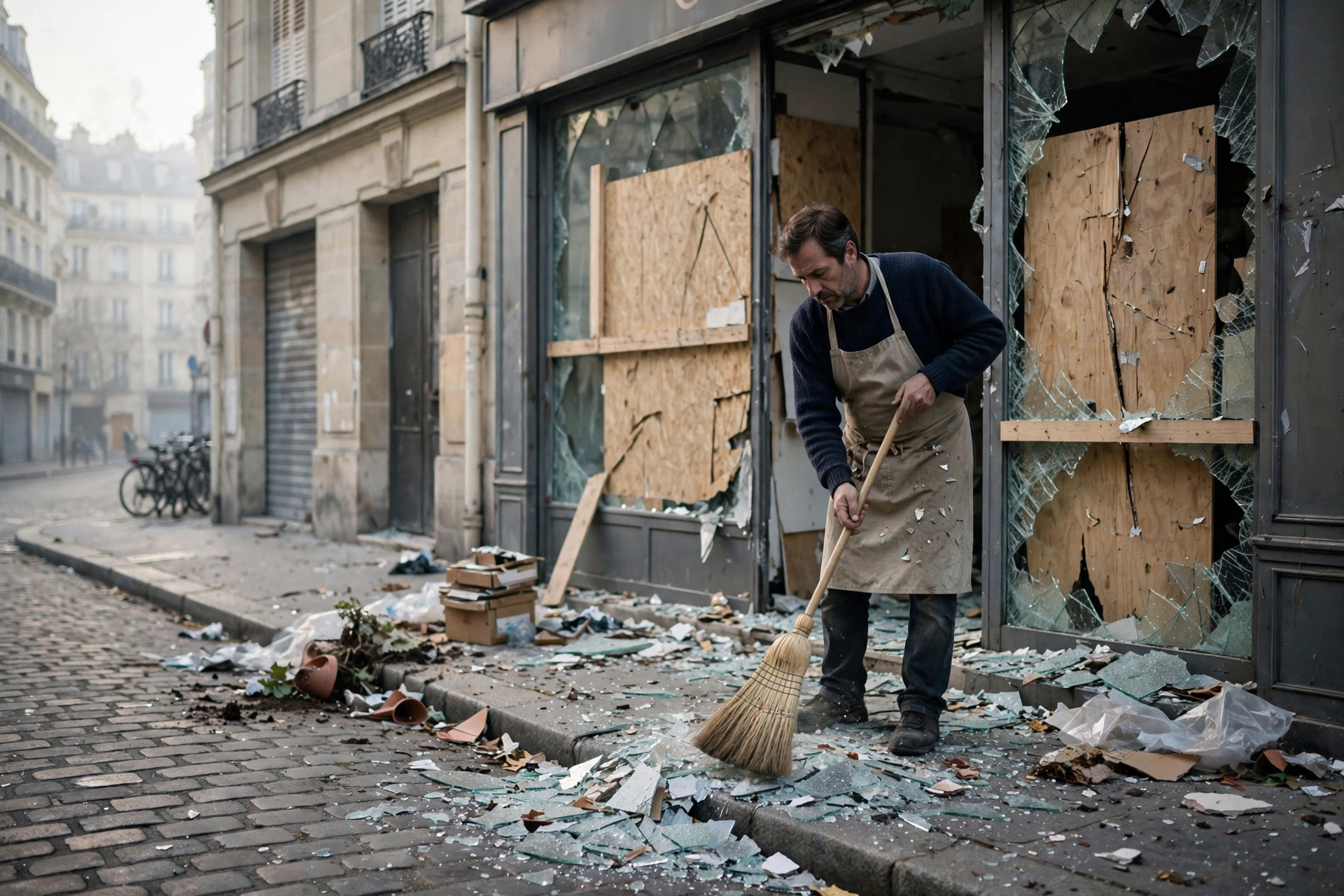
Back home, the political fallout is building. The government has blamed what it calls far-left groups — “opportunistic delinquents who had seen a chance to pillage and loot,” in Nuñez’s phrase — and France’s media landscape is now consumed by the argument over whether the state did enough to prevent the destruction. Lecornu called Saturday “an escalation in violence,” adding that “it’s a miracle the toll wasn’t higher.”
What’s notable is how the weekend compressed so many French anxieties into 48 hours: school conditions, fuel prices, grocery bills, wages that don’t stretch far enough, a weak economy and mounting public debt. Saturday’s marches — roughly 550,000 people nationwide by official count, up to 800,000 by the organizers’ — were among the largest protest days in recent French history. For most of the day they were peaceful. Then, on the margins in more than twenty cities, hooded groups formed, and the evening belonged to them.
And France is not the only place where economic pressure on ordinary people has boiled over. Earlier this month, Mauritius imposed a curfew after its worst riots in decades — a reminder that the collision of street anger and state power can ignite almost anywhere the squeeze gets tight enough.
Why the next marches matter more than the address
Here’s the uncomfortable truth about Sunday’s speech: addresses like this rarely end movements. They either calm them — or fail to. And the movement behind the France riots has shown an unusual ability to mutate: from school blockades in September, to cost-of-living marches, to trade-union-backed national demonstrations, to the violent fringe that hijacked Saturday night.
Macron’s gamble is that firmness on the looters plus acknowledgment of the youth will split the peaceful from the violent. The risk is that the “deep anguish” he named on television — about the future, about finding one’s place — isn’t answered by prefects banning protests or by dialogue meetings at Matignon. If October’s next marches draw hundreds of thousands again, the president’s words will be measured against the streets, and the streets don’t do nuance.
For now, France is counting: the arrests, the injured officers, the smashed shopfronts, the burned heritage. The question hanging over all of it — the one Macron himself posed — is how French people could do this to France. The harder one is what France does next.
FAQ: Macron’s national address and the France riots
What did Macron say in his national address?
On Sunday, October 18, Emmanuel Macron addressed France after its worst riots in years, saying “we all feel anger and shame,” vowing looters would pay for damage and be brought to justice, while acknowledging young protesters’ “deep anguish” about the future. He stopped short of declaring a state of emergency but said prefects could ban protests to protect buildings and businesses.
How many people were arrested during the France riots?
France’s Interior Ministry reported roughly 2,400 arrests nationwide over the weekend, including 855 in Paris, per the Associated Press. Nearly 1,000 police officers and gendarmes were injured, seven seriously. One protester died in Paris after a cardiac arrest during Saturday’s demonstrations.
What happened in Limoges during the riots?
On Saturday evening, masked rioters broke into the 143-year-old Limoges town hall and set it on fire, gutting the historic building — its clock tower and roof collapsed. More than 15 people were arrested in connection with the arson, which local officials called a “catastrophe for heritage.”
Are the France protests over?
No. Clashes and attempted looting continued on a smaller scale in Paris and Lyon on Sunday, even after Macron’s address. Prime Minister Lecornu has been tasked with convening parties and unions, and further protest days are expected — the movement has grown continuously since student blockades began in mid-September.
The bottom line
Macron’s address was two speeches in one: compassion for the young and furious, and a fist for the masked looters. It named the anguish driving France’s streets — and refused to let violence hide behind it. But speeches don’t rebuild town halls, calm tear-gas choked boulevards, or stretch a household budget. With 2,400 arrests, a thousand injured officers, a dead protester, and a president in his final years of power, France’s crisis has moved from the streets to the political arena. The next marches will tell us whether “anger and shame” was a turning point — or just a televised pause before the next weekend.