
Kyiv Under Ballistic Barrage: Russia’s Overnight Attack Kills 1, Shuts Metro Stations, Leaves 550,000 Without Power
Kyiv’s metro stations are supposed to be the safest place in the city. During every major attack, thousands of Ukrainians pack into the underground stations, sleeping on platforms and in trains while sirens wail above them. In the early hours of Monday, October 19, that assumption cracked — literally. Russian ballistic missiles struck Kyiv’s above-ground metro infrastructure, damaging stations, rupturing rails, and forcing officials to shut down two stations in the capital’s east.
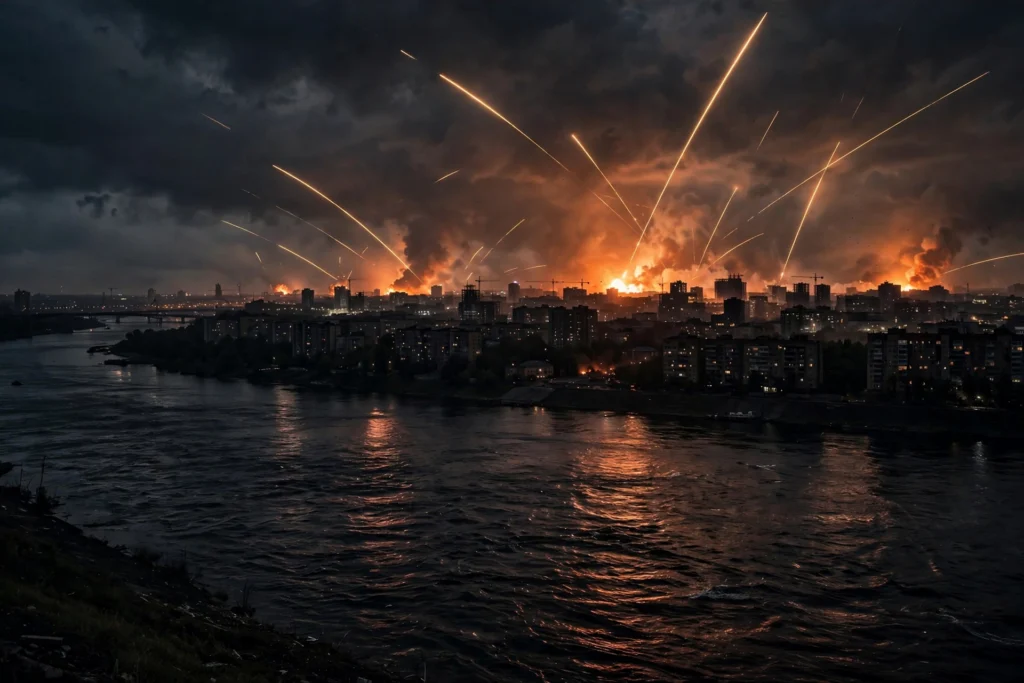
It was one of the heaviest combined assaults of the year: at least 16 ballistic missiles aimed at the capital region, cruise missiles, and roughly 200 drones — including what Ukraine’s defense ministry described as jet-powered Shaheds — all in a single night. By dawn, one 21-year-old woman was dead, at least eight more people were injured, 550,000 families had lost power, and the city’s residents were waking up to another morning of darkened streets and burning buildings.
Three Waves of Strikes in One Night
The attack didn’t come as a single barrage. It came in waves. Journalists on the ground and Ukrainian monitoring channels reported the first explosions just before 11 p.m., a second round around 3 a.m., and a third near 7 a.m. Air raid sirens sounded simultaneously with — or in some cases moments after — the first blasts, The Kyiv Independent reported, giving residents virtually no time to reach shelter.
Ukraine’s Air Force said Russia launched a large-scale overnight air attack combining ballistic missiles, cruise missiles, and 269 drones. Ukrainian air defenses destroyed or suppressed 243 drones and four missiles — an interception rate that looks impressive on paper but still left 25 locations struck across the country and debris raining down in eight more.
President Volodymyr Zelenskyy said the assault targeted the Kyiv region as well as Kharkiv and Dnipro. “Energy facilities were the main target, but a clinic, a school, a metro station and homes were also hit,” Ukraine’s Ministry of Defense said in a statement. “There are casualties.”
Moscow, for its part, described the operation as a “massive strike” using ground-based high-precision weapons and attack drones. Russia’s Ministry of Defense said it had hit defense-industry sites in the Kyiv region — facilities storing cruise missiles and drones, a data center, a locomotive depot where missiles were stored, a logistics hub it said held components for drones and Flamingo cruise missiles, and a plant it claimed made polymer materials for the military-industrial complex. It also claimed to have struck a bulk carrier at sea, some 130 kilometers southwest of the Odesa port, that was allegedly carrying military and dual-use cargo. As with most such claims from either side in this war, the military status of every site struck could not be independently verified.
Metro Stations Hit — The City’s Shelters Take Damage
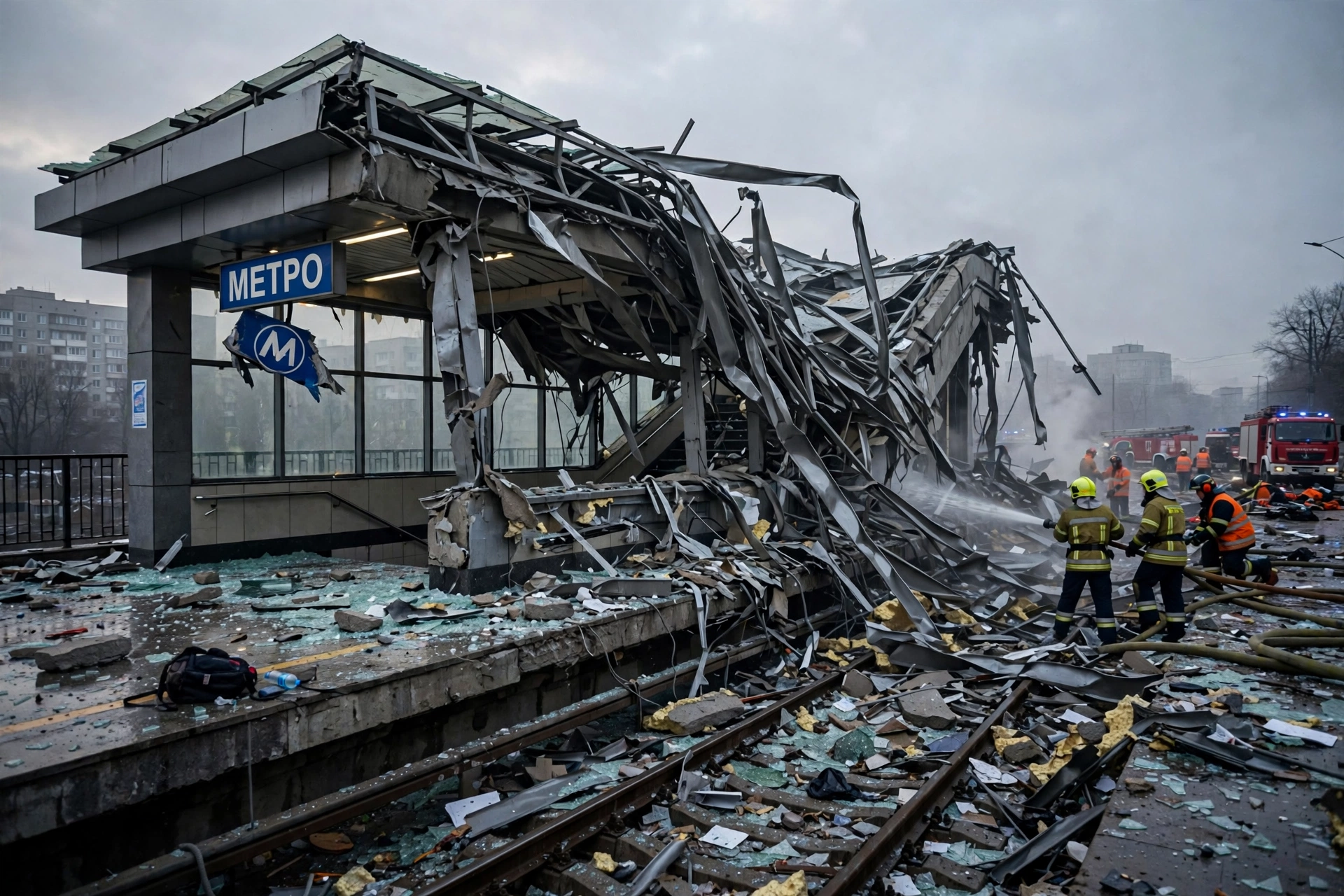
Perhaps the most symbolically jarring damage of the night hit the metro system itself. In the Desnianskyi district, a blast damaged the Chernihivska station and ruptured the running and contact rails nearby, Mayor Vitali Klitschko said. The same district saw a non-residential building catch fire — the blaze that killed a 21-year-old woman. Officials ordered the above-ground Chernihivska and Lisova stations closed through the morning rush for urgent repairs, a rare disruption for a network that has doubled as the city’s bomb shelter for years.
The damage didn’t stop at the metro. In the Solomianskyi district, a 25-story residential building sustained heavy damage and five people were injured. A medical center in the same district took a direct hit: the blast wave shattered more than 200 windows, blew out doors and ceilings, and damaged medical equipment. Miraculously, no staff were hurt and no patients were inside at the time. Social media imagery showed extensive damage to the Cosmo Multimall shopping and entertainment center in the same neighborhood. In the Dniprovskyi district, debris damaged educational institutions, a sports facility, and non-residential buildings.
Ukraine’s State Emergency Service documented damage across at least three municipal districts, and strikes were also recorded in settlements in Kyiv Oblast surrounding the capital.
Power Out for 550,000 Families
Beyond the blast damage, the most widespread impact was on the power grid. Ukrainian officials said Russian strikes had knocked out power for some 550,000 families and damaged more than 10 energy infrastructure facilities. Repair crews were dispatched overnight, but the scale of the outages — stretching across Kyiv, Kharkiv, Dnipro, and beyond — underscored how systematically Moscow has continued to target Ukraine’s energy lifelines.
Zelenskyy said there had been “no early warning from our partners” that the missile attack was imminent — a pointed remark aimed at the Western intelligence-sharing arrangements that have become a political football in Washington. Just hours before the attack, Secretary of State Marco Rubio had publicly denied that the United States had paused intelligence sharing with Ukraine, even as Putin pushed for a trilateral summit with Trump and Xi to discuss ending the war.
An Escalation Cycle Nobody Can Stop
Here’s the part that should worry everyone, not just Ukrainians: this attack did not come out of nowhere. Over the weekend, Ukraine carried out one of its largest-ever drone campaigns against Russia, with Moscow saying it had shot down some 1,015 drones near Moscow and several western regions — one of the largest attacks of the war. Drones struck a major oil terminal in St. Petersburg and other targets across western Russia. Monday’s massive strike on Kyiv looks, at least in part, like retaliation — which means each side’s “success” this weekend became the justification for the other side’s assault days later.
This is the escalation cycle that peace diplomacy keeps failing to break. Trump declared last weekend that the two sides had agreed to a “ceasefire” — a claim that was met with skepticism then and looks increasingly hollow now, with Russia continuing to pound Ukraine’s energy infrastructure without pause. The so-called energy ceasefire has never held, and Monday’s events buried whatever was left of it.
What makes this cycle particularly grim is that both sides are now striking deeper, with newer weapons — jet-powered drones on Russia’s side, mass swarms of over 1,000 drones on Ukraine’s — and the civilian buffer between military targets and neighborhoods keeps shrinking. A medical center with no patients inside is still a medical center. A metro station is still a shelter people rely on. When 243 of 269 drones get shot down and the city still burns in 25 places, the interception statistics stop mattering to the family sitting in the dark.
FAQ
How many people were killed in the October 19 Kyiv attack?
One person — a 21-year-old woman in the Desnianskyi district — was confirmed dead, and at least eight others were injured, according to Kyiv Mayor Vitali Klitschko and Ukrainian authorities. Some Ukrainian monitoring sources reported higher injury counts; the figures may be updated as rescue work continues.
Which Kyiv metro stations were damaged?
The Chernihivska and Lisova stations sustained structural damage, with debris rupturing the running and contact rails near Chernihivska. Both stations — which are above ground in eastern Kyiv — were closed for urgent repairs on the morning of October 19.
How much power was knocked out?
Ukrainian officials said some 550,000 families lost power after more than 10 energy infrastructure facilities were damaged in the strikes, which also targeted Kharkiv and Dnipro. Repair crews were deployed overnight.
What did Russia claim it targeted?
Russia’s Ministry of Defense said the “massive strike” targeted defense-industry sites in the Kyiv region, including drone and cruise-missile storage facilities, a data center, a locomotive depot, and a logistics hub for drones and Flamingo cruise missiles. It also claimed a strike on a bulk carrier near Odesa. These claims could not be independently verified.
The Bottom Line
Monday’s attack on Kyiv was not just another night of war — it was a message. Hitting metro stations, the one piece of infrastructure every Ukrainian trusted as a refuge, and cutting power to 550,000 families just as winter approaches, shows a campaign designed as much to break civilian morale as to degrade military capacity. The trilateral summit talk, the ceasefire claims, the denials about intelligence sharing — all of it sounds distant from a city where sirens went off after the explosions had already started. Until someone breaks the retaliation cycle, Kyiv’s residents will keep waking up to darkness, debris, and the question nobody in Washington or Moscow seems able to answer: how much longer?