
Nepal Flash Flood: Budhi Gandaki River Sweeps Away Homes and Bridges, Villagers Evacuated
It didn’t arrive with rain. It arrived with a roar — at four in the morning, when the villages along Nepal’s Budhi Gandaki River were still asleep. By sunrise on Sunday, a Nepal flash flood had swallowed homes whole, torn bridges off their foundations, and forced riverside villagers to flee to higher ground in the remote Gorkha district. Authorities report no casualties so far.
If you’ve ever slept near a mountain river, you know its nighttime sound: a steady, almost comforting rush. Ask the people of Chumnubri what they heard on Sunday morning, and they’ll tell you it stopped sounding like a river. It sounded like an avalanche of water — because that’s essentially what it was.
What Happened in Gorkha on Sunday Morning
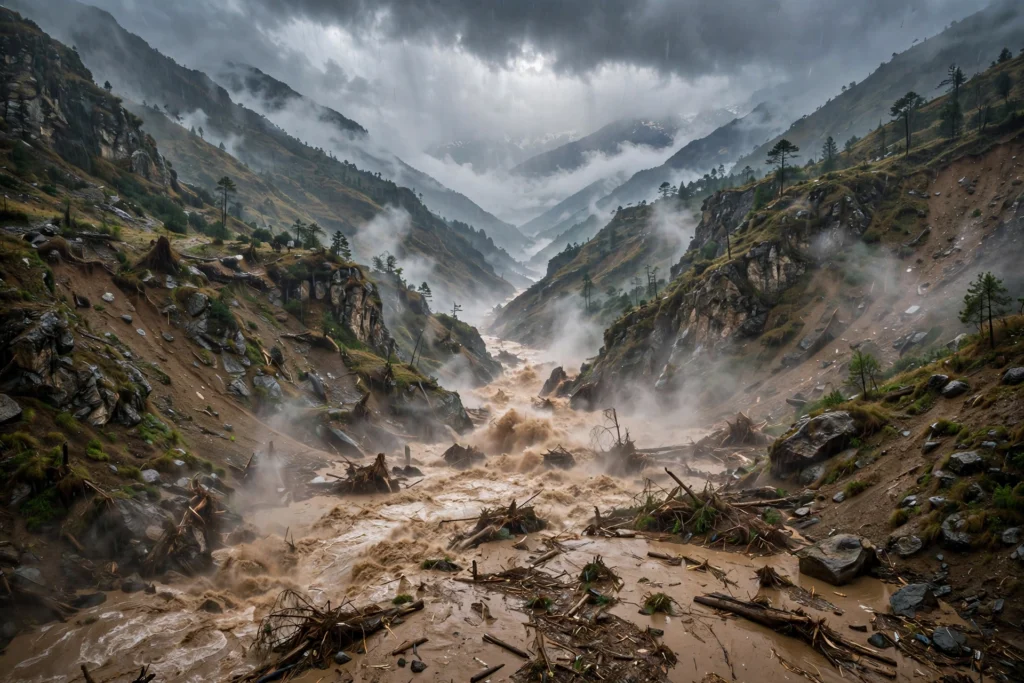
Around 4 AM on October 11, the Budhi Gandaki River — a major tributary of the Trishuli, flowing through Nepal’s central Gorkha district roughly 100 kilometers west of Kathmandu — surged violently out of its channel. The water came thick with mud and sludge, carrying trees, boulders, and debris torn from the mountainsides.
Local officials told the news agency ANI that residents were woken by the deafening sound of the river. The Ungilung and Syar streams — smaller tributaries feeding into the Budhi Gandaki — had swollen to terrifying levels in the darkness.
By 6:40 AM, Nepal’s National Disaster Risk Reduction and Management Authority (NDRRMA) was blasting out SMS alerts along the river: a large flood was racing down from Chumnubri Rural Municipality-6, and everyone between there and Trishuli Dobhan should stay away from the river and get to high ground.
No Casualties Reported as Villagers Evacuate
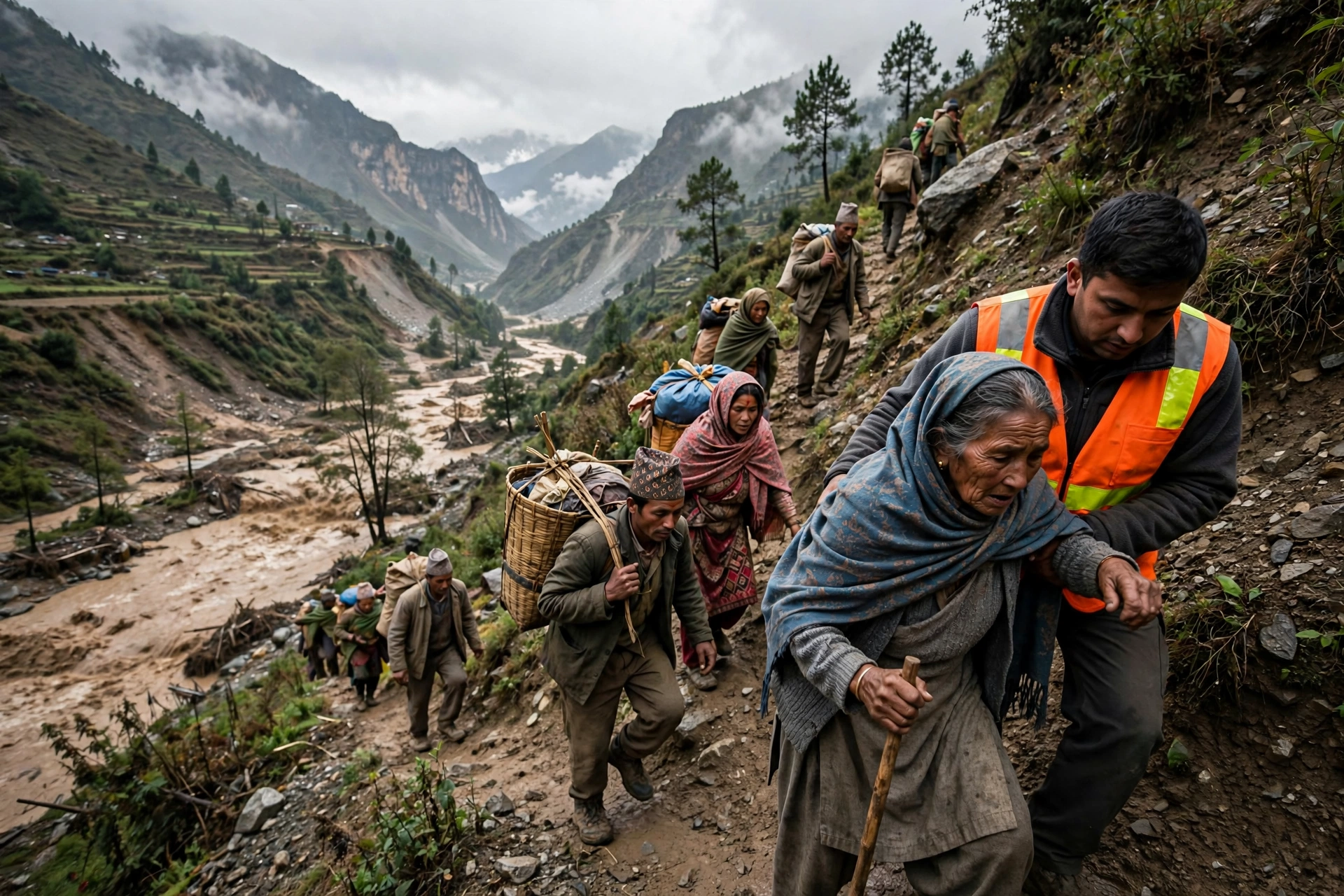
Gorkha’s Chief District Officer, Dharmendra Kumar Mishra, told ANI that no casualties had been reported as ground teams continued gathering updates on Sunday. Reuters, reporting from Kathmandu, confirmed the destruction — two suspension bridges destroyed and a hydroelectric project damaged — but likewise reported no confirmed deaths or missing persons.
Residents along the river were urged to move to higher ground after Nepal’s National Disaster Risk Reduction and Management Authority issued SMS flood alerts at 6:40 AM, and army and police rescue personnel reached the affected area on Sunday morning to assist with the evacuation.
Homes, Bridges and a Hydropower Project Swept Away
As the morning wore on, the scale of the destruction started to come into focus — and it’s staggering.
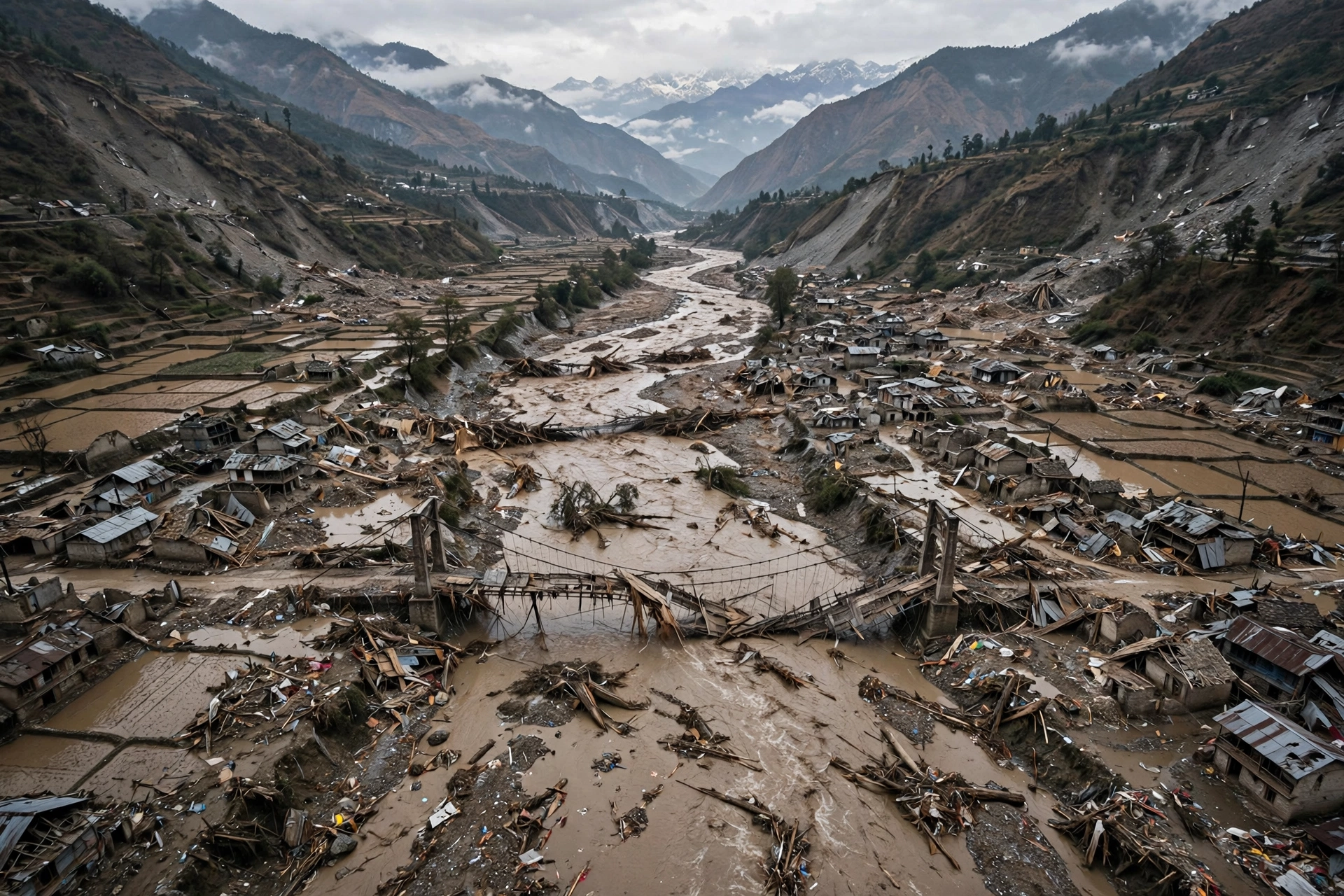
Preliminary reports indicated that five to seven houses standing in the riverbed at Jagat were swept away entirely, with more houses destroyed further downstream. The Nepal Energy Forum reported that 35 houses in the Paiyu and Bagar villages were washed away, and a motorable bridge connecting Soti and Manbu in Aarughat Rural Municipality was torn apart.
Reuters, reporting from Kathmandu, confirmed that two suspension bridges had been destroyed and that a hydroelectric project in the area suffered damage. The flooding also wiped out the construction camp of the 341 MW Budhi Gandaki Hydropower Project at Salleri — a semi-reservoir project estimated to cost around 70 billion Nepali rupees — sweeping away equipment along with the camp itself.
Why Did the River Suddenly Turn Violent?
So what makes a river explode like this on a Sunday morning with no major storm in the headlines? The working theory, according to district officials, is both simple and terrifying: a landslide dam.
A dry landslide struck near Chumnubri village, and the debris blocked the river’s natural flow — in one account, a landslide near the Ungilung river sent flooding through the Syar river into the Budhi Gandaki. In another, local administrator Narayan Sapkota said the flow may have been blocked at Chekampar, with a landslide dam forming in the Syar Khola before bursting.
When a landslide dams a river, water piles up behind the blockage, sometimes for hours or days, invisible to the people downstream. Then the dam gives way — and everything that was held back arrives all at once, in a single violent wall. Villages downstream get no warning, because the river can look deceptively normal right up until the moment it isn’t.
Officials said the exact cause is still being investigated, but the landslide-dam theory fits everything witnesses described: the sudden timing, the enormous volume, and the mud-thick water.
The Evacuation Race Against the River
Nepal’s disaster authorities moved fast. The NDRRMA flood forecasting section issued alerts for settlements along the river across five districts — Gorkha, Tanahun, Chitwan, East Nawalparasi and West Nawalparasi — urging residents to move to safe locations and asking the public to help get people in at-risk areas out in time and assist search and rescue operations.
Army and police rescue personnel reached the affected area on Sunday, and officials were also monitoring the situation from a helicopter — no small thing in Nepal’s steep, road-poor mountain terrain, where a washed-out bridge can cut a village off from the world in minutes.
It’s the same cruel race emergency crews everywhere face when water starts rising: get people out before the river decides for them. Crews in the United States ran that exact race earlier this week when Hurricane Isaias forced mass evacuations along the Gulf Coast — proof that whether it’s a hurricane or a landslide dam, the math of moving people uphill ahead of water never changes.
A Country That Knows This Pain Too Well
What makes Sunday’s flood land so heavily is the context. According to Reuters, the Budhi Gandaki flows downstream of another tributary where a glacier collapse in August triggered a catastrophic flood that killed 1,457 people, with thousands still missing.
Let that number sit with you: 1,457. Two months ago. And now the same river system has surged again.
Nepal’s geography is both its wonder and its curse. The Himalayas that draw trekkers from around the world are also a landscape of hanging glaciers, unstable slopes, and rivers that can turn from lifelines into weapons overnight. Climate scientists have been warning for years that warming temperatures are destabilizing glaciers and increasing the frequency of exactly these kinds of sudden, violent floods.
And it’s been a brutal stretch for natural disasters globally: just days ago, a magnitude 7.6 earthquake shook Panama. October 2026 is turning into one of those months where the planet seems determined to remind us who’s in charge.
Nepal Flash Flood: Frequently Asked Questions
Were any casualties reported in the Nepal flash flood?
No. Nepal’s disaster authorities report no casualties so far. Gorkha’s Chief District Officer Dharmendra Kumar Mishra told ANI that no deaths or missing persons had been confirmed as ground teams continued their assessment on Sunday, October 11. Riverside villagers were evacuated to higher ground as a precaution.
What caused the Budhi Gandaki River flood?
The leading theory is that a landslide blocked the river’s flow — possibly in the Syar Khola near Chekampar — creating a natural dam that burst, sending pent-up water surging downstream all at once. Officials say the exact cause is still under investigation.
How much damage did the flood cause?
Early reports describe dozens of homes swept away — including 35 houses in Paiyu and Bagar villages and five to seven houses at Jagat — plus two destroyed suspension bridges, a washed-out motorable bridge, and the construction camp of the 341 MW Budhi Gandaki Hydropower Project, along with its equipment.
Is the area still in danger?
Yes. Nepal’s disaster authority issued flood alerts across five districts (Gorkha, Tanahun, Chitwan, East Nawalparasi and West Nawalparasi) and urged everyone near the river to stay on high ground until the flood passes, while authorities monitor the situation from the ground and by helicopter.
The Bottom Line
Dozens of homes are gone. Bridges that took years to build vanished in minutes. And all of it happened in the dark, with almost no warning, on a river that had already shown what it could do two months ago. But as of Sunday, authorities report no casualties — a fact worth holding onto amid the wreckage.
The rescue effort in Gorkha is still underway, with army and police personnel on the ground and flood alerts in force across five downstream districts. The bigger question hangs over the whole Himalayan region: in a warming world, how many more Sunday mornings like this one are coming?
For now, the people of the Budhi Gandaki valley are doing what mountain people have always done after the water takes everything: climbing to higher ground, counting who’s there, and starting over. The least the rest of us can do is pay attention.