
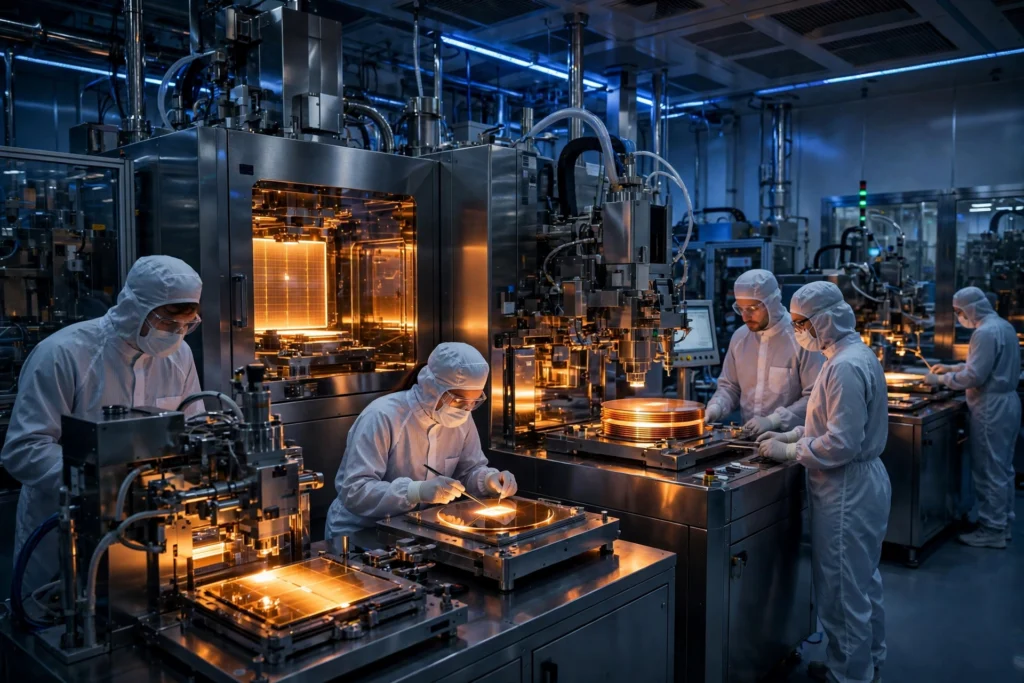
TSMC Posts Record Profit for Sixth Straight Quarter as AI Chip Boom Refuses to Slow Down
Stop me if you’ve heard this one before: a company prints more money than analysts thought possible, on the back of a technology nobody can stop talking about. Except this time, it’s the sixth time in a row — and the numbers keep getting bigger.
Taiwan Semiconductor Manufacturing Company, the world’s largest contract chipmaker, has posted a record third-quarter net profit of NT$763.1 billion (roughly $23.4 billion), up a staggering 68.7% from a year earlier. The result blew past the NT$746.3 billion consensus estimate compiled by LSEG, whose SmartEstimates lean on the forecasts of analysts with the most accurate track records. Revenue hit NT$1.49 trillion (about $46.36 billion), also beating expectations and even topping TSMC’s own guidance range.
Let that sink in. Six consecutive quarters of record net profit. Eleven straight quarters of profit growth. In an industry famous for boom-and-bust cycles, TSMC has turned the chip cycle into a one-way escalator.
The AI Boom Is Paying the Bills — Literally
So what’s driving it? Two letters, one syllable: AI.
High-performance computing — the category that includes the AI accelerators and data-center processors at the heart of the artificial intelligence buildout — accounted for a massive 68% of third-quarter revenue, up from 57% just a year earlier. Revenue from the segment jumped 22% from the previous quarter alone. Smartphones, the business that once defined TSMC, are now a supporting act at 21%.
The technology mix tells the same story. Chips built on TSMC’s 3-nanometer process — the most advanced silicon in mass production, and the stuff inside Nvidia’s flagship AI accelerators — made up 33% of revenue, the largest single technology share. These are the chips the world is fighting over, and TSMC is virtually the only company that can make them at scale.
Profitability was just as eye-catching. TSMC’s operating margin hit 58.7%, above the top end of its own 58% guidance — a sign of genuine pricing power in a market where leading-edge chip supply remains tight. Gross margin came in at 66.4%. For context, most manufacturers would frame a 30% operating margin. TSMC nearly doubles it.
A Record Set on the Worst Possible Week
Here’s what makes this earnings report genuinely remarkable: the timing.
Hours before TSMC’s numbers landed, South Korea’s benchmark Kospi index plunged more than 8% intraday and tripped a market-wide circuit breaker — only the fifth such halt of the year. Samsung Electronics and SK Hynix, the memory-chip makers feeding the AI boom, were dumped by investors sweating over the debt piling up behind AI infrastructure spending. CoreWeave, the cloud provider that rents Nvidia GPUs to AI labs, has watched its bond yields climb toward 15%.
The market’s fear is simple: AI companies are borrowing enormous sums to build data centers, and if the returns don’t materialize, the whole chain wobbles. TSMC’s answer? An actual record — real cash, real margins, real demand.
“The world’s largest contract chipmaker’s chips sit inside every major AI accelerator on the market,” Reuters reported, and that position is exactly why the debt fears haven’t dented TSMC’s order book. You can question valuations and bond yields all day. But someone still has to physically manufacture the chips, and for the most advanced ones, there is essentially one foundry on Earth that can do it.
Not Just Taiwan Anymore: The $265 Billion American Bet
TSMC is also spending its windfall to redraw the map of chip manufacturing. The company is investing a planned $265 billion to build chip factories in Arizona — including an additional $100 billion unveiled earlier this year — the largest single foreign direct investment in US history.
And it may not stop there. Reuters reported last month that TSMC is evaluating a potential investment in Texas, which would further extend its American footprint. Elon Musk added fuel to the rumor mill, saying his companies would build and operate the Terafab AI chip complex, with TSMC potentially subleasing part of it.
The strategy is clear: keep the crown jewels in Taiwan, but give nervous Western customers a hedge. With AI chips now treated as strategic assets by governments, TSMC’s geographic expansion is becoming almost as important as its technology lead.
What the Analysts Saw Coming (and Still Underestimated)
Perhaps the most telling detail is that even the experts lowballed it. TSMC’s revenue of $46.36 billion came in roughly $1 billion above the top of its own guidance. Free cash flow soared to NT$476.56 billion, up from NT$139.38 billion a year earlier.
CEO C.C. Wei has repeatedly described AI demand as “very strong” and “unrelenting” — phrases that are starting to sound like understatements. With a market capitalization around $2 trillion, TSMC is now Asia’s most valuable company and worth nearly double its South Korean rival Samsung Electronics.
The ripple effects are worth watching, too. As the AI gold rush intensifies, even Microsoft is racing to build its own Maia 300 AI chip to reduce dependence on external supply — but it, like Nvidia, Apple, and essentially every hyperscaler, still leans on TSMC’s fabs for the leading-edge silicon. Meanwhile, Anthropic’s push toward a $350 billion valuation shows the AI spending wave feeding TSMC’s order book shows no sign of cresting.
FAQ: TSMC’s Record Quarter, Explained
How much profit did TSMC make in Q3?
TSMC reported third-quarter net profit of NT$763.1 billion (about $23.4 billion), up 68.7% from a year earlier — beating the LSEG consensus estimate of NT$746.3 billion and marking the company’s sixth straight quarter of record net profit.
Why is TSMC doing so well?
Relentless demand for AI chips. High-performance computing, the segment covering AI accelerators and data-center processors, made up 68% of revenue. TSMC is the only foundry that can mass-produce the most advanced 3-nanometer chips, giving it enormous pricing power — reflected in a 58.7% operating margin.
Who are TSMC’s biggest customers?
Nvidia and Apple are the marquee names. Nvidia’s AI accelerators and Apple’s processors are built on TSMC’s leading-edge processes, alongside chips for other major tech giants.
Is TSMC building factories outside Taiwan?
Yes. TSMC plans to invest $265 billion in chip factories in Arizona — the largest foreign direct investment in US history — and is reportedly evaluating a further investment in Texas.
The Bottom Line
Markets can argue about AI debt, bond yields, and circuit breakers. TSMC just answers with arithmetic: six straight record quarters, an 11th consecutive quarter of profit growth, margins most companies can only dream of, and an order book stuffed with the most sought-after manufacturing capacity on the planet. The AI boom has skeptics. It does not have a shortage of TSMC chips — and until that changes, the foundry in Taiwan keeps printing money.