

US Orders Embassy Staff and Families Out of Saudi Arabia as Houthi Attacks Kill at Airport and Oil Field
Washington does not order its diplomats out of a country on a whim. So when the State Department told non-emergency US government employees and their families to leave Saudi Arabia on Wednesday, it was saying something loud and clear: the kingdom is no longer safe enough to call business as usual.
The trigger was a brutal day of Houthi attacks. One person was killed and eight were wounded at a civilian airport in Dammam, in eastern Saudi Arabia. Hours apart, debris from an intercepted drone killed two foreign contractors at the Shaybah oil field near the UAE border and wounded two more. The US government has seen enough — and it’s getting its people out.
How did it get this dangerous, this fast? And what does the withdrawal mean for a region sliding toward a wider war?
What the US Announced — and What It Didn’t
The order covers “non-emergency US government employees and their family members” in Saudi Arabia — a formal step known as an ordered departure, which Washington reserves for situations where the security environment has genuinely deteriorated. State Department spokesperson Tommy Pigott announced the move in a post on X, explaining that “Iranian-supported Houthis have increasingly engaged in hostilities against Saudi Arabia, including attacks on civilian airports and other critical infrastructure resulting in civilian casualties and severe travel disruptions.”
But almost as interesting as the announcement was the clarification that followed. Media reports had suggested Washington was preparing departures from diplomatic missions across the Gulf — the United Arab Emirates, Jordan, Qatar and Bahrain. Pigott pushed back hard, insisting the ordered departure applies to Saudi Arabia only. Four US officials told Reuters, though, that Washington is also planning to withdraw family members from several other missions in the region. The truth may be messier than the official line.
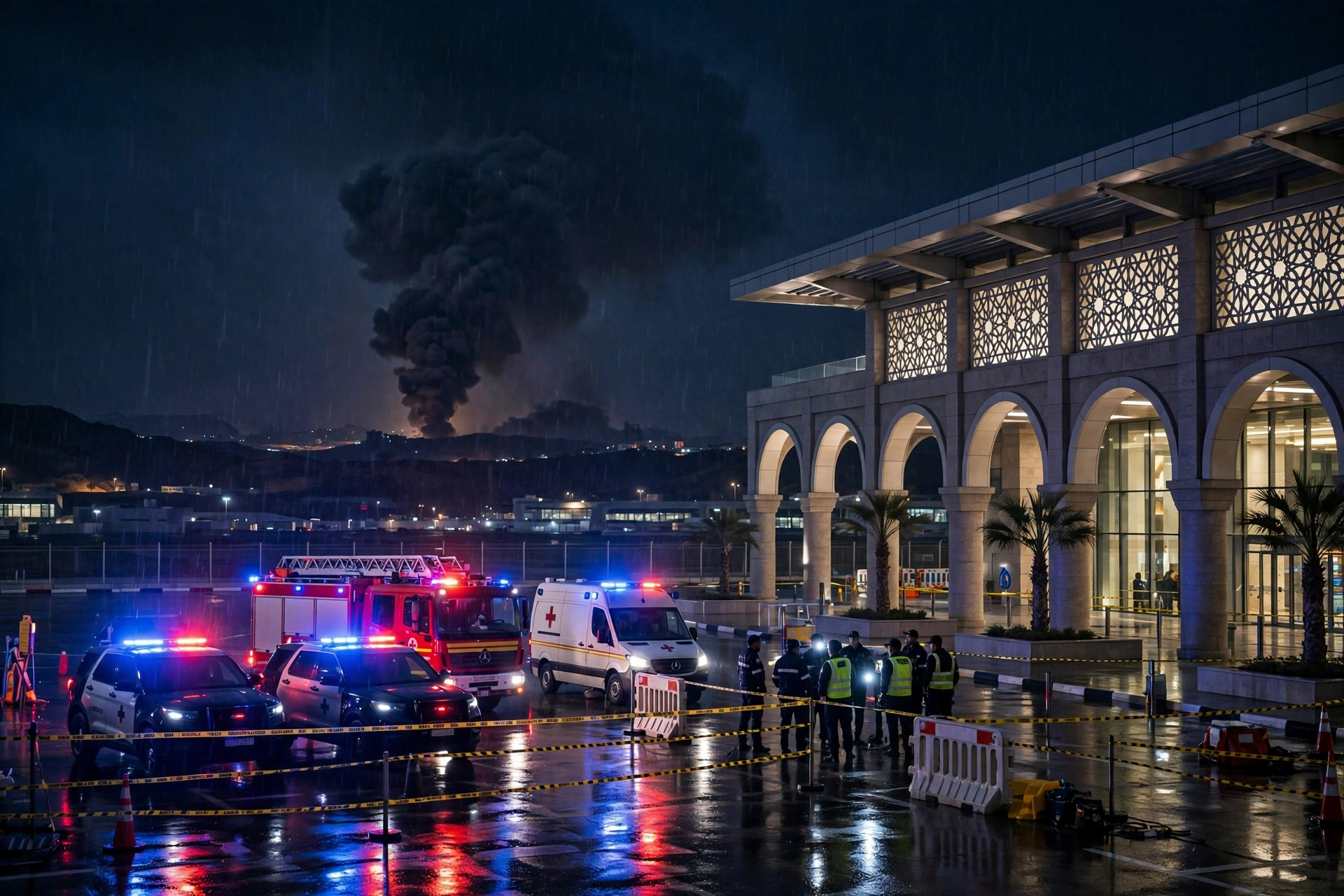
A Deadly Day: Dammam Airport and the Shaybah Oil Field
The attacks that forced Washington’s hand came late Wednesday, and they were not random. At King Fahd International Airport in Dammam, the strike killed one person and wounded eight others, according to Saudi civil aviation authorities. The airport — one of the largest in the kingdom — became the latest civilian target in a campaign that has deliberately hit the places ordinary Saudis gather and travel.
The second blow landed hundreds of kilometers away, deep in the desert at the Shaybah oil field near the UAE border. A drone targeted at the facility was intercepted, but the falling debris killed two contractors — a Filipino and a Nepali — and injured two others, the Saudi energy ministry said. It was a grim reminder that even Saudi Arabia’s sophisticated missile defenses cannot stop every attack.
The Saudi-led coalition said it intercepted six drones on Wednesday alone, including five aimed at the Eastern Region and the holy city of Madinah. The Houthi movement claimed responsibility for the airport strikes, saying — without providing evidence — that the facility was being used to transport military hardware to Yemeni government forces.

Why This Is Happening Now
None of this came out of nowhere. In June, a four-year-old truce in Yemen’s civil war collapsed, reviving a conflict that has raged since 2014 and drawn in Saudi Arabia since 2015. Since then the Houthis — backed by Iran — have stepped up a campaign of drone and missile attacks that Saudi Arabia says have become near-daily this month.
This is also not the first time Saudi airports have been in the crosshairs. Earlier this month, Storion News reported on a Houthi missile strike on Riyadh’s airport that killed civilians — the kingdom’s deadliest airport attack in years. Wednesday’s strikes on Dammam and Shaybah are an escalation of that same campaign, reaching further into the kingdom’s east and hitting its economic arteries.
The Houthis say they are responding to the Saudi-led coalition’s offensives in Yemen. Saudi officials describe it as Iranian-directed aggression. Either way, the trajectory is unmistakable: more attacks, more casualties, and now, the first American diplomatic withdrawal of this conflict.
A Region Bracing for the Worst
The departure order landed in the middle of a week of ominous signals across the region. On Monday, dozens of Israeli fighter jets flew over Syria and Iraq toward the Iranian border in what Israel described as a deterrence exercise — a flight path some US officials read as a provocation toward Iran. The timing is not subtle: Israel holds elections on October 27, and Prime Minister Benjamin Netanyahu said this week that the only way to remove the threat from Iran is to overthrow its regime.
President Trump, for his part, did not rule out a new offensive against Iran, according to reports. And late Wednesday, Iranian state media reported the sound of explosions in the southern Hormozgan province overlooking the Strait of Hormuz — a province that sits on the world’s most important oil chokepoint, where a maritime crisis earlier this month left thousands of sailors stranded.
This is the third time this year Washington has moved its people out of harm’s way in the Gulf: it ordered non-essential staff to leave ahead of the US war against Iran that began in late February, and again in July before Trump called off a planned new wave of strikes. Each time, the departures have been a prelude to — or a hedge against — American military action. That history is why diplomats across the region are watching this order so nervously.
What Happens Next
The immediate questions are practical. Thousands of Americans live and work in Saudi Arabia — will the order expand beyond government employees? Will other Western governments follow Washington’s lead and pull their own people out? And what happens to the big events the kingdom has lined up, like WWE’s Crown Jewel in Riyadh on November 7, which is already facing questions about whether it can go ahead safely?
The bigger question is whether the ordered departure is a precaution — or a signal. The US has been walking a tightrope in the region all year: fighting a war with Iran, backing Saudi Arabia, and trying to avoid a regional explosion. Moving diplomats’ families out is what governments do when they think the tightrope is about to snap. Whether this ends with de-escalation or with the war widening further, Wednesday’s attacks have made one thing clear: the Houthi campaign against Saudi Arabia is no longer a distant border conflict. It is killing people in the kingdom’s airports and oil fields — and Washington has decided it cannot wait to see where it goes next.
Frequently Asked Questions
Why did the US order embassy staff to leave Saudi Arabia?
The State Department cited escalating Houthi attacks on Saudi civilian airports and critical infrastructure that have caused civilian casualties. An ordered departure — mandatory evacuation of non-emergency staff and families — is Washington’s standard response when a host country’s security environment deteriorates sharply.
Does the departure order apply to all US embassies in the Gulf?
No — at least not officially. State Department spokesperson Tommy Pigott clarified that the ordered departure applies to Saudi Arabia only, rejecting reports of a region-wide evacuation. However, four US officials told Reuters that Washington is also planning to withdraw family members from some other Gulf missions, so the picture may still evolve.
Who was killed in the latest Houthi attacks?
One person was killed and eight injured in the attack on Dammam’s King Fahd International Airport, according to Saudi civil aviation authorities. Separately, two foreign contractors — a Filipino and a Nepali — were killed and two others injured when debris from an intercepted drone struck the Shaybah oil field, the Saudi energy ministry said.
Has the US ordered departures from the Gulf before?
Yes, twice this year. Washington ordered non-essential staff to leave the Gulf before the start of the US war against Iran in late February, and again in July before President Trump called off a new wave of strikes. Both times the move preceded or hedged against American military action.
The Bottom Line
An ordered departure is Washington’s loudest diplomatic alarm bell short of closing an embassy. The US is telling its people to leave Saudi Arabia because Houthi drones are killing civilians at airports and oil fields — and nobody in Washington believes the attacks are about to stop. With Israeli jets buzzing toward Iran, explosions reported across the strait, and a US president refusing to rule out new strikes, the region is one miscalculation away from something much bigger. The departure order is not just about the safety of diplomats. It is a sign that the people running American foreign policy think the worst may still be ahead.