
Pope Leo XIV Has Lung Cancer: Vatican Confirms Diagnosis After Surgery at Rome’s Gemelli Hospital
Three days ago, Pope Leo XIV lung cancer was not a phrase anyone was thinking about. The pontiff had just stood at his window, calmly telling the world about a small nodule on his lung, reassuring pilgrims it was caught early, and asking for their prayers before a routine-sounding surgery. What happened in the operating room on Tuesday afternoon changed the story — and the Vatican’s blunt announcement that followed is being read word by word around the world.
Here is the news, stated plainly: the pope has lung cancer. He is 71, he has just had part of his right lung removed, and he is expected to spend roughly a week in the hospital recovering. The Vatican says the operation was a success — but it has not said everything, and those unanswered questions are what 1.4 billion Catholics are waiting on.
What the Vatican Announced on Tuesday
On October 13, after what was expected to be a straightforward operation to remove a lung nodule, the Holy See Press Office released a medical bulletin from the pope’s doctors, Dr. Luigi Carbone and thoracic surgeon Professor Stefano Margaritora. The bulletin confirmed what pre-operative tests had suspected: tissue examined during the surgery showed the growth was lung adenocarcinoma, a form of non-small cell lung cancer.
The announcement was notable for its directness. There was no softening of the language, no euphemism — the Vatican simply named the disease. Adenocarcinoma is the most common subtype of non-small cell lung cancer, developing in the outer regions of the lungs and striking even people who have never smoked. And that candor is a pattern: openness about papal health gained momentum under the late Pope Francis, and Leo appears to be continuing it.
The Surgery: A 90-Minute Operation That Went Further Than Planned
What was supposed to be the removal of a small nodule turned into something more serious. The pope spent roughly three hours in the operating room, though the operation itself lasted about 90 minutes. Surgeons used a video-assisted technique — a minimally invasive, camera-guided approach — and removed the entire lower lobe of the pope’s right lung.
Why does that detail matter? Because removing a lobe, rather than just the nodule, is the decision surgeons make when they want the procedure to be curative. A rapid tissue examination during the operation confirmed the adenocarcinoma diagnosis on the spot.
The Vatican says the pope woke from anesthesia as expected, spent a short period under observation, and then returned to his room on the hospital’s 10th floor. He is expected to remain in the hospital for at least a week — the same timeline doctors projected before the surgery.
What Is Lung Adenocarcinoma — And What Does the Diagnosis Mean?
Let’s be careful here, because this is where headlines can outrun the facts. The Vatican has confirmed what the pope has — lung adenocarcinoma. It has not disclosed the cancer’s formal stage, whether it has spread to lymph nodes or beyond, or whether further treatment such as chemotherapy or targeted therapy will follow. Final pathology results will determine all of that, and none of them are public yet.
So what can be said? Doctors describe adenocarcinoma as a cancer that develops in the glandular cells of the lung, accounting for roughly 40% of all lung cancers. When it is found localized — as the pope’s nodule was described when he announced it — surgical removal is often the main treatment, and the prognosis is substantially better than for advanced disease. The American Cancer Society puts the five-year relative survival rate for localized non-small cell lung cancer at about 67%.
But — and this is important — no honest doctor would read a prognosis off those numbers for this specific patient. A successful operation does not automatically mean every cancer cell is gone. The pope’s personal outlook depends on details the Vatican has not released. Until it does, the most truthful sentence anyone can write is this: the surgery went well, and the rest is still unknown.
How We Got Here: The Calm Sunday Announcement
It is worth rewinding to Sunday, October 11, because the contrast is striking. Speaking after the Angelus prayer from his apartment window, the pope himself revealed the nodule — discovered during routine medical examinations, detected at an early stage, well-contained. He said his doctors had advised surgery, and that he had decided to follow their advice. Then he asked the crowd for prayers.
He walked into Gemelli Hospital on Tuesday morning greeting crowds. Nobody outside the medical team knew the operation would end with a cancer diagnosis. For the full story of that announcement, see our earlier report on Pope Leo XIV’s planned lung surgery.
There is something quietly remarkable about how this played out. The first American-born pope — born in Chicago, known for being physically active and in good health — chose to deliver his own health news personally, twice over: the nodule on Sunday, and now, through his doctors, the diagnosis on Tuesday. Whatever else this papacy will be remembered for, its honesty about its own fragility is already part of the story.
Rome Reacts: Rosaries, Candlelight, and a Hospital Chapel
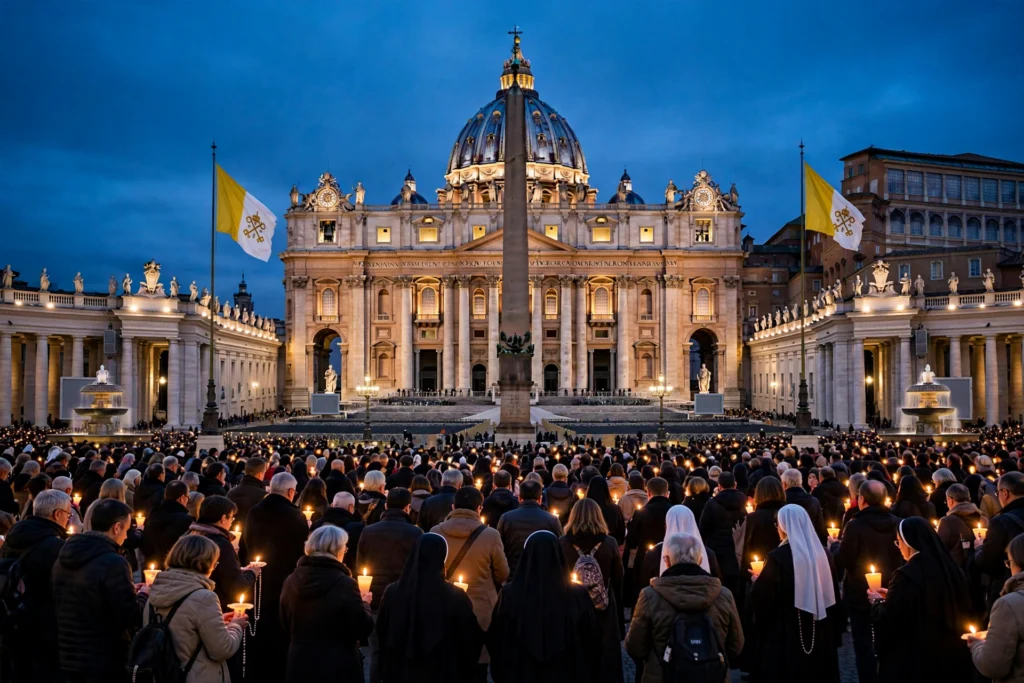
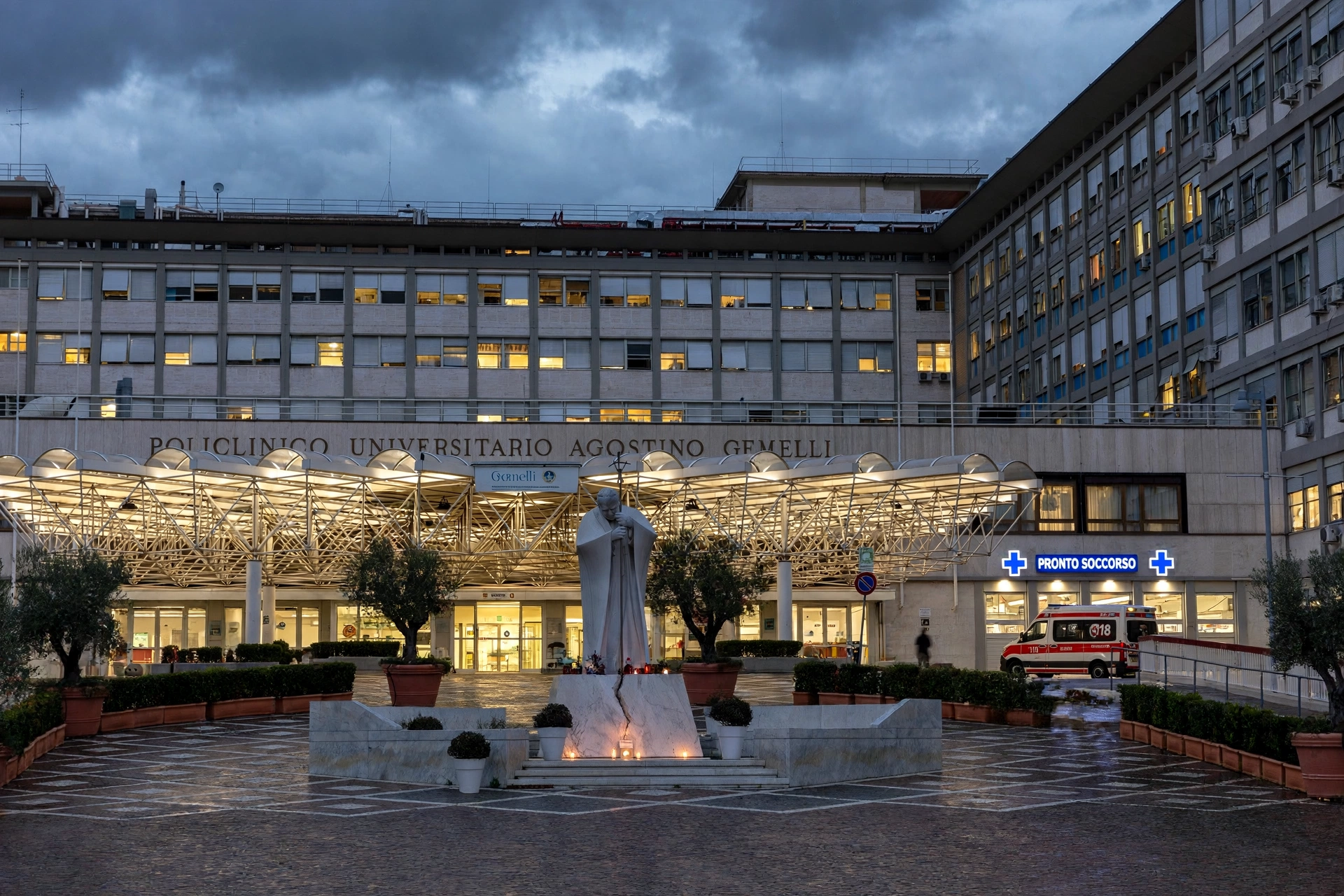
Outside Gemelli Hospital, the response was immediate and unmistakable. Cardinal Baldassare Reina, the vicar general of the Diocese of Rome, led a rosary service in the hospital chapel, with dozens of faithful gathered inside and parishes across Rome invited to join the prayer broadcast by the Vatican. Well-wishers clustered outside the hospital gates, many drawing reassurance from the fact that the disease was caught before it ever produced a single symptom.
Cardinal Pietro Parolin, the Vatican’s secretary of state, told reporters the pope had seemed “very calm” when they met on Monday — the eve of surgery. One small, human detail that emerged: Gemelli has a permanent papal suite where Pope Francis spent more than a month during his serious illness last year, but according to the AP it is currently under renovation — so Leo is recovering in a regular room on the 10th floor instead.
What Happens to the Vatican While the Pope Recovers?
The practical questions start now. All of the pope’s public engagements have been cancelled through October 20, and he will spend roughly a week in the hospital under observation. The machinery of the Holy See does not stop — the Vatican has run through popes’ illnesses before — but the concentration of attention this week will be on the pope’s room on the 10th floor.
History offers a steadying perspective. Popes have undergone serious surgery and returned to full schedules — Francis’s own colon surgery in 2021 was followed by years of active pontificate. Still, at 71, with part of a lung removed, the coming days matter enormously.
Frequently Asked Questions About Pope Leo XIV’s Lung Cancer Diagnosis
What type of lung cancer does Pope Leo XIV have?
The Vatican confirmed the diagnosis as lung adenocarcinoma, a type of non-small cell lung cancer. It is the most common subtype, accounting for roughly 40% of lung cancers, and it can occur in people who have never smoked. The diagnosis was confirmed during the operation on October 13, 2026, matching what pre-operative tests had suspected.
What surgery did the pope undergo?
Surgeons at Rome’s Gemelli Hospital performed a right lower lobectomy using a video-assisted, minimally invasive technique — removing the entire lower lobe of the pope’s right lung. The operation itself lasted about 90 minutes within a roughly three-hour operating-room stay. The Vatican described it as successful, with no complications.
What is the pope’s prognosis?
The Vatican has not released a formal cancer stage or detailed prognosis, so no individual prediction is responsible. What is known: the growth was detected before it caused any symptoms, the surgical aim was curative, and final pathology results will determine whether further treatment is needed. The pope is expected to remain hospitalized for about a week.
How is the Vatican handling the pope’s duties during his recovery?
All public engagements are cancelled through October 20, and the pope is resting under medical observation at Gemelli Hospital. Vatican operations continue under the curia’s normal procedures. For background, read our earlier report on the pope’s lung surgery announcement.
The Bottom Line
A pope announced a nodule on Sunday. On Tuesday, the world learned it was cancer. Between those two days lies a story about the kind of papacy this is turning out to be — one that tells its people the truth, quickly, and then asks for their prayers. The medical facts will unfold over the coming weeks: the pathology results, the question of further treatment, the slow return to the balcony of St. Peter’s. For now, the most important sentence from Rome is also the simplest. The surgery was a success. The pope is recovering. And an entire Church is holding its breath with him.