
SpaceX Just Spent $8 Billion on Wireless Airwaves — Your Next Phone Carrier Might Be a Rocket Company
SpaceX Just Spent $8 Billion on Wireless Airwaves — Your Next Phone Carrier Might Be a Rocket Company
How many times have you watched your phone bars vanish the moment you step into an elevator, a basement, or a quiet country road? Elon Musk’s rocket company just spent $8 billion on the rights to fix that — and it wants to sell you phone service too. On October 8, SpaceX struck a deal that sent Verizon, AT&T, and T-Mobile’s stocks tumbling, wiped tens of billions off their market value, and put the company on a direct collision course with the entire US wireless industry. Here’s what actually happened, and why your carrier is suddenly very nervous.
The $8 Billion Deal, Explained Simply
On Thursday, Grain Management — a telecom investment firm most people had never heard of — announced a definitive agreement for SpaceX to acquire its entire nationwide portfolio of 800 MHz wireless spectrum. The two companies did not disclose the price, but The Wall Street Journal, citing people familiar with the matter, reported that SpaceX would pay about $8 billion in cash. Reuters first reported the deal’s announcement, and coverage has since spread across the financial press.
The portfolio covers up to 14 MHz of paired low-band frequencies — the 817–824 MHz and 862–869 MHz ranges — blanketing the entire United States. But this is not a done deal yet: the transfer still requires approval from the Federal Communications Commission, plus other customary closing conditions.
What makes the story even spicier is where this spectrum came from. Grain had only just acquired the portfolio from T-Mobile back in August 2026, paying with a mix of cash and its own 600 MHz holdings. Back then, SpaceX and satellite rival AST SpaceMobile were already reported to be competing for the same licences, then valued at around $6 billion. Two months later, SpaceX appears to have won — and paid a hefty markup to do it.
Why 800 MHz Changes Everything for Starlink Mobile
Here’s the physics lesson that explains the panic on Wall Street. Radio frequencies behave very differently depending on where they sit on the dial. High-band frequencies can carry enormous amounts of data, but they die the moment they hit a wall. Low-band frequencies like 800 MHz carry less data per channel, but they travel far longer distances and punch through walls, roofs, and tree cover — the exact obstacles that have limited satellite phone service for decades.
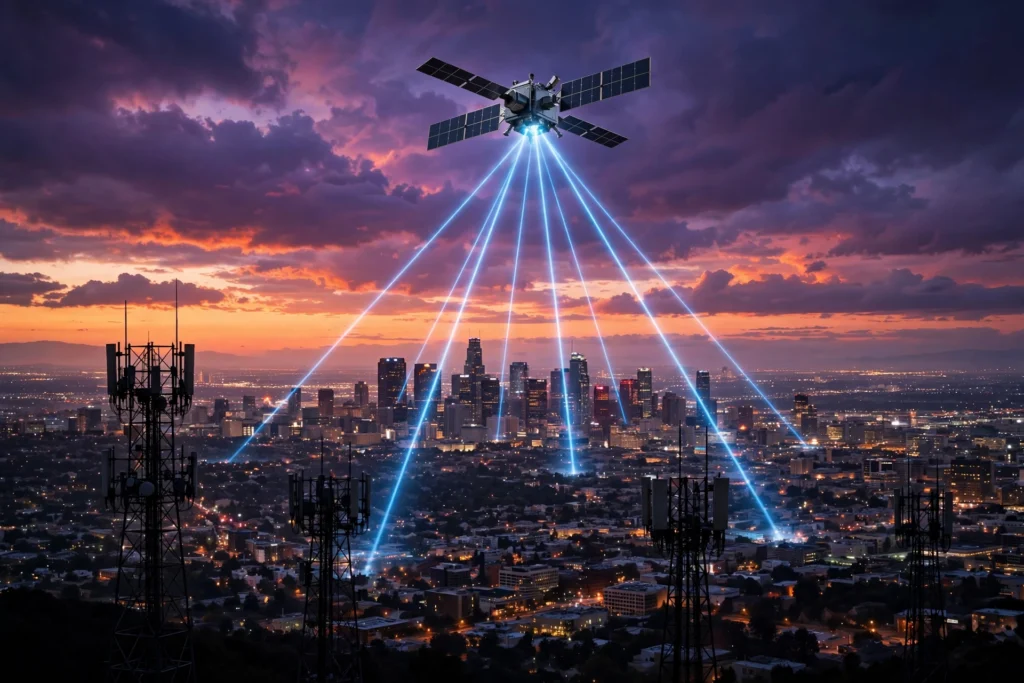
SpaceX already had the first half of the puzzle: 2 GHz mid-band spectrum it secured through its earlier EchoStar deal, which carries high-bandwidth traffic from its satellite fleet. What it lacked was the low-band layer that works indoors. Starlink’s satellites, orbiting hundreds of miles up, can already connect ordinary phones outdoors for messaging and limited data. But getting a usable signal to someone standing in their kitchen? That was the gap. The 800 MHz purchase closes it — at least on paper.
SpaceX says the combined setup will make Starlink Mobile “the first operator to deploy both satellite and terrestrial spectrum” — one network that keeps you connected indoors, outdoors, in cellular dead zones, and everywhere in between. According to its FCC filing, the company plans to build its own ground network to use the band: towers, rooftop sites, and standard wireless equipment. This is no longer just a satellite company. This is a carrier build-out.
Wall Street Freaked Out — and the Numbers Are Wild
The market’s verdict arrived fast. In extended trading on Thursday, Verizon, AT&T, and T-Mobile each fell roughly 6%. The next trading day was worse: Verizon dropped nearly 9%, AT&T fell almost 10%, and T-Mobile plunged more than 13%. Together, the three giants lost close to $39 billion in market value in a single day — nearly five times what SpaceX paid for the spectrum that spooked them.
Meanwhile, the stocks of companies that own the towers surged. Crown Castle, American Tower, and SBA Communications all rallied, because even a space-based carrier needs steel on the ground — a point Bernstein analyst Madison Rezaei drove home in a Thursday note, writing that “buying spectrum is not a commitment to build a nationwide network” but that this is “the spectrum we thought SpaceX needed to make that option more credible — and less expensive.”
The money trail tells its own story: this month alone, Big Tech’s buying spree has been extraordinary. Amazon is reportedly in talks to acquire the AI startup Decart for about $7 billion — see our coverage of Amazon’s reported $7 billion AI acquisition — and SpaceX’s $8 billion spectrum grab continues the same theme: the giants of tech are spending like there’s no tomorrow to own the infrastructure of the future.
Your Phone Already Supports It — That’s the Scary Part
If SpaceX were asking customers to buy special satellite phones, the carriers could breathe easy. They’re not. The 800 MHz band is one of the most widely supported frequencies in the world — the vast majority of smartphones in your pocket right now can already receive it. That removes the classic adoption barrier for any new network: no new hardware, no dongle, no antenna.
Think about what that means. When OpenAI rolled out GPT-6 to 1.2 billion ChatGPT users this week, it showed how fast a tech platform can reach the masses once the distribution channel is in place. SpaceX’s distribution channel is literally falling from the sky — and now, through the walls of your house too. The combination of a satellite constellation plus terrestrial towers, all speaking to phones people already own, is exactly the kind of zero-friction rollout that keeps incumbent CEOs awake at night.

What Stands in the Way: The FCC and 15,000 New Satellites
Nothing here is guaranteed. The Grain Management deal still needs the FCC’s blessing, and regulators could attach conditions or take months to decide. Then SpaceX has to actually build the thing — and that is where the second half of this week’s news comes in.
The FCC separately approved Starlink Mobile’s second-generation satellite constellation: up to 15,000 Gen2 satellites, optimized for 2 GHz service worldwide. SpaceX claims the new fleet will deliver more than 100 times the bandwidth of the current one, enabling high-speed service directly to unmodified phones. The regulator also cleared a full range of backhaul bands for the company’s V3 broadband satellites, letting them tie into Starlink’s existing gateway network.
Even the analysts aren’t fully sold. Rezaei noted that low-band spectrum makes a 2027 launch of Starlink Mobile more cost-effective — fewer towers are needed to cover the same ground — but buying the airwaves isn’t the same as building the network. And the carriers aren’t going down without a fight: expect legal challenges, lobbying, and aggressive pricing the moment SpaceX shows any sign of signing up real subscribers.
The broader stakes go beyond phone bills. As Microsoft CEO Satya Nadella called for an AI “kill switch” this week — read about the AI kill-switch debate — the same handful of companies are quietly buying up the physical infrastructure of modern life: chips, data centers, and now the airwaves themselves. Whoever controls the signal controls the conversation.
Frequently Asked Questions
What exactly did SpaceX buy?
SpaceX agreed to acquire Grain Management’s entire nationwide portfolio of 800 MHz wireless spectrum licences — up to 14 MHz of paired low-band frequencies covering the whole US — for a reported $8 billion in cash. The deal needs FCC approval before it can close.
When will Starlink Mobile actually launch?
Analysts point to 2027 as the target for the consumer launch of Starlink Mobile. The FCC has now approved up to 15,000 second-generation satellites for the service, and SpaceX says it will combine the satellite constellation with a ground-based network once regulators sign off.
Will I need a new phone to use it?
Almost certainly not. The 800 MHz band is already supported by the vast majority of smartphones in use today, which is precisely what makes this deal so threatening to AT&T, Verizon, and T-Mobile.
Does the deal mean the end of Verizon, AT&T and T-Mobile?
Not yet — and maybe not ever. Analysts stress that buying spectrum is not the same as building a nationwide network, the FCC still has to approve the transfer, and the incumbent carriers have deep pockets, massive subscriber bases, and decades of network experience. But losing nearly $39 billion in market value in a day suggests investors think the threat is very real.
The Bottom Line
A rocket company just paid $8 billion for the right to send radio waves through your walls — and your carrier’s stock price is the clearest evidence that this is not a publicity stunt. Between the 800 MHz spectrum, the 2 GHz capacity from the EchoStar deal, 15,000 newly approved satellites, and a planned ground network of towers, SpaceX has assembled every piece of a real mobile carrier. The FCC’s decision is the next domino, and Wall Street’s $39 billion verdict says the old guard knows exactly what’s at stake. The question isn’t whether the wireless industry is changing — it’s whether AT&T, Verizon, and T-Mobile will adapt in time, or become the next Blockbuster in a streaming war. Watch this space — and your signal bars.
Sources: reporting from Reuters, The Wall Street Journal (via secondary coverage), Morningstar/MarketWatch, The Register (via SpaceX statement), and Bernstein analyst research, as published in the financial press on October 8–9, 2026.
Pingback: Jay Stratton UFO Book: Pentagon UFO Chief Breaks Silence on 80-Year Cover-Up Claims