

Storm Adam Drowns Eastern Spain in Historic Floods: At Least 4 Dead, Over 1,000 Rescued
Two years ago, the streets of Valencia ran with a kind of water nobody wants to see again. This weekend, it came back. Storm Adam stalled over Spain’s eastern coast and emptied an almost unthinkable amount of rain on towns that are still rebuilding from the last disaster. At least four people are dead, more than 1,000 have been rescued, and hundreds of thousands were told to lock their doors and stay inside. If you’re wondering how much rain it takes to break a coastline, the answer, this time, was measured in hundreds of litres per square metre — in a single day.
“Historic rainfall” is a phrase that gets thrown around a lot. This one earned it.
A DANA like the one Spain will never forget
Meteorologists have a technical name for what hit: a DANA — an isolated upper-level low, a bubble of cold air trapped high above the warm Mediterranean that simply refuses to move. Spain’s national weather agency, AEMET, named Adam the first high-impact DANA of the 2026–27 season, and its Special Notice 37/2026 warned of 60 to 90 millimetres of rain per hour along the southern Valencia coast.
The reality was worse than the forecast. In L’Atzúvia, near Alicante, a staggering 713 litres of rain per square metre fell. In Pego, the tally reached 632 litres in just 36 hours — 465.2 millimetres of it on Monday, October 19, alone, per AEMET observations reported by The Watchers.
Why so much rain, so fast? Because September had just been the hottest on record for mainland Spain, according to AEMET — and the summer before it the warmest ever. A scorching Mediterranean holds more moisture, and when cold air collided with it, the sky unloaded. Two years after the floods of 2024, Spain is discovering that its new climate extremes are not a one-off. They are the weather now.
The toll: four dead, thousands of lives upended
Authorities have confirmed at least four deaths linked to the storm. Two of them were in Oliva, the coastal town that took the worst of the deluge. There, a 79-year-old woman with reduced mobility was found dead on the ground floor of her home as rescue teams swept the flooded streets — her niece was pulled out alive. In the same town, a 64-year-old man suffered a fatal cardiac arrest at a flooded campsite. A third victim, a woman, died at a beach in Sagunto, and a fourth drowned after being swept away by a swollen stream in Catalonia while trying to cross rising water with her family, government delegate Pilar Bernabé confirmed.
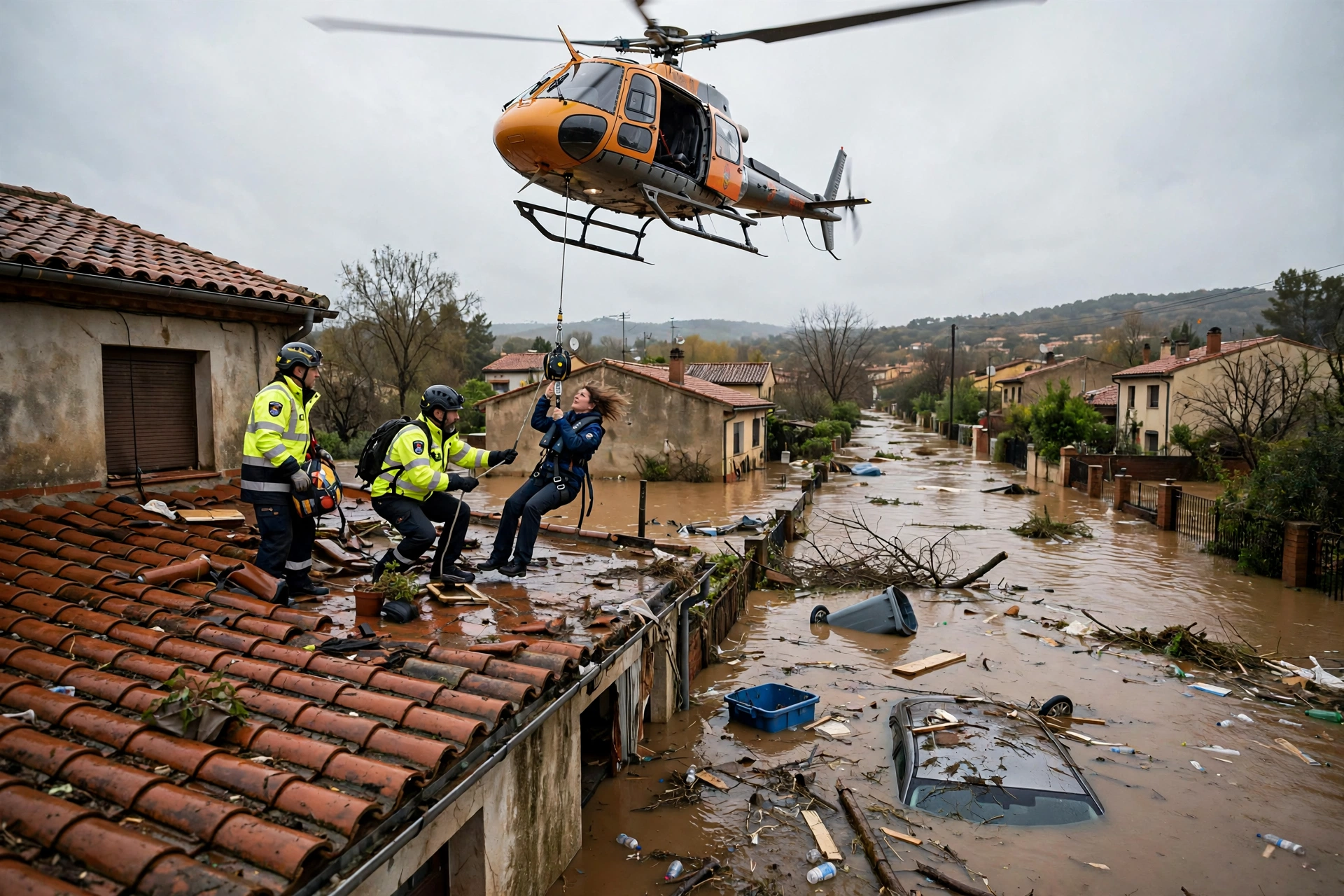
The rescues were the real story of Monday, October 19. Security forces carried out more than 400 rescues in the Valencia region alone, Bernabé said, and the Civil Guard reported nearly 100 more across Valencia and Alicante. Helicopters winched stranded residents from rooftops; boats reached homes that had become islands. More than 1,000 rescues were carried out in a single day, according to emergency tallies reported by The Watchers. Roughly 2,000 campers were evacuated from seven campsites in Oliva, and more than 100,000 students stayed home as schools closed.
At the height of the emergency, around 800,000 residents were under shelter-in-place orders, authorities confirmed on Monday morning. By late afternoon the figure had fallen to 87,000 across eight municipalities as water receded — a measure of how quickly the crisis both surged and began to ease.
Oliva, Pego and the towns that drowned
If you want to understand what 700 litres of rain looks like, look at Oliva. The town’s mayor, Enrique Moll, told public regional broadcaster À Punt radio on Monday that all routes into the town were blocked and several residents were still waiting to be evacuated by helicopter from their rooftops. Deputy mayor Salvador Llopis told state broadcaster TVE that emergency services were going house to house rescuing trapped residents — many of them elderly — with floodwater at waist height inside their homes.
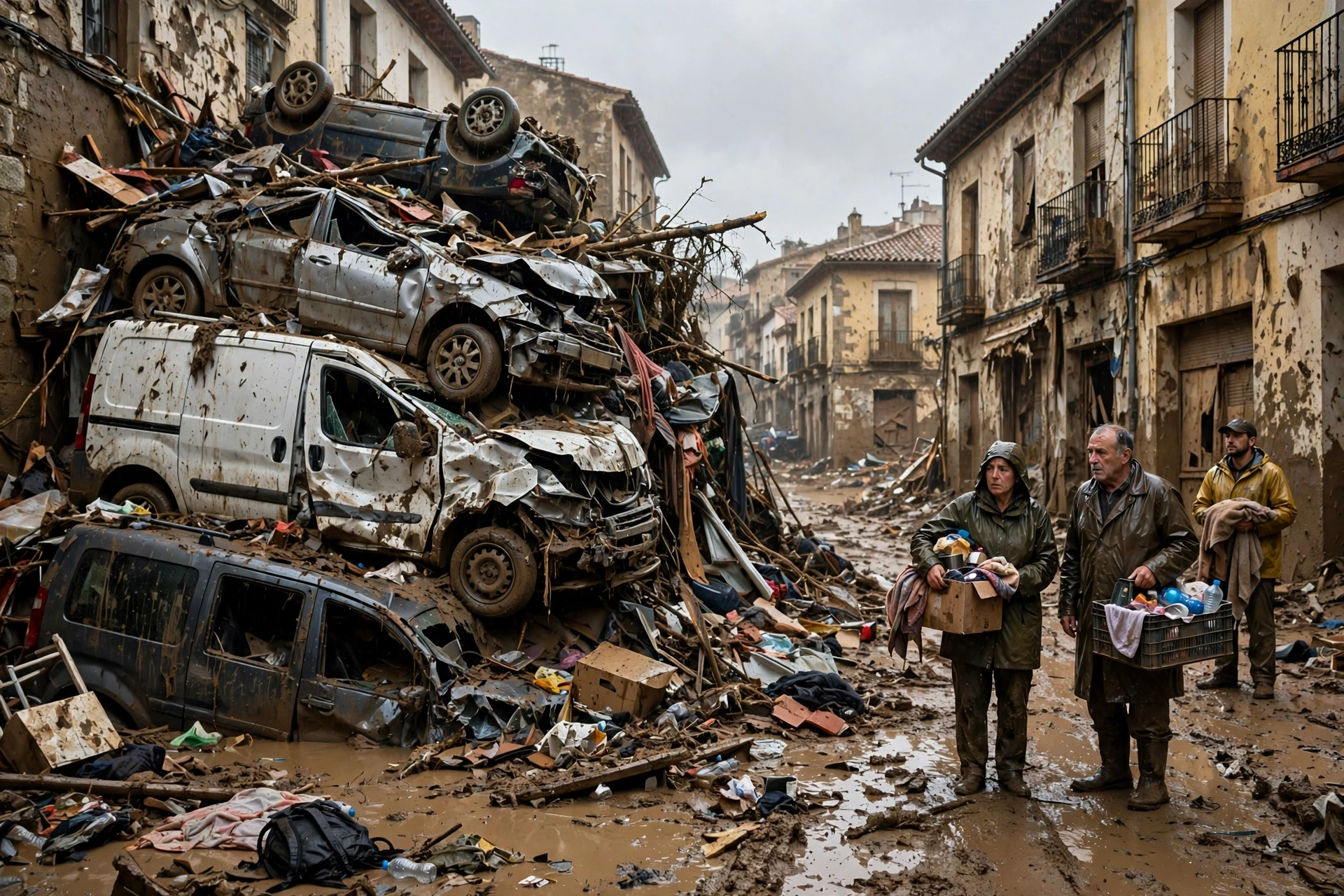
In Els Poblets, northeast of Alicante, floodwater piled cars and vans on top of one another in the streets. Local resident Javier Fornez captured the cruel repetition of it all: “Some people have lost everything all over again, just like in 2007, when exactly the same thing happened.”
The storm didn’t spare the islands either. At Ibiza airport, water cascaded through terminal ceilings while runway issues forced flight diversions to Alicante and Majorca. Units of the Military Emergency Unit (UME) deployed rapidly from their base in Bétera to assist overwhelmed local teams.
Spain’s painful lesson from 2024 seems to have helped: when the first red alerts went up, residents stayed put. Roughly 100 municipalities in the Balearic Islands and Catalonia were told to remain indoors for several hours on Monday; most restrictions lifted by early afternoon. Two years ago, confusion over warnings was blamed for part of the catastrophic death toll. This time, the orders were loud, early and widely obeyed.
The shadow of 2024
You can’t write about this storm without naming the ghost in the room. In late 2024, torrential rain turned the Valencia region into a death trap: about 230 people died, entire neighbourhoods were destroyed, and the disaster became one of Spain’s worst natural catastrophes in modern memory. A parliamentary reckoning followed. Warnings were reformed. And yet here we are, two years later, with the same streets under water.
The difference so far is scale — and, perhaps, preparedness. The 2024 disaster struck with little effective warning. This time, AEMET’s red and orange alerts, the mobile phone blasts, and the memory of 2024 itself pushed hundreds of thousands indoors before the worst arrived. The death toll, awful as it is, does not approach that of two years ago. But for the families in Oliva who buried a mother this week, that is no consolation.
It is also a reminder that Spain’s disasters are getting more extreme, not less. The hottest September on record. The warmest summer on record. Then the first high-impact DANA of the season, dumping nearly a year’s worth of rain in a day and a half. If the “historic” flood is now a biennial event, how do you build a coastline that survives it?
Elsewhere in the region, extreme weather is testing authorities in very different ways — from deadly flash floods in Nepal to the wildfire haze that forced Malaysian schools to shut this month. You can read our recent coverage of the Nepal flash flood disaster and the Indonesian wildfire smoke crisis in Malaysia for a sense of how widespread this season’s extremes have been.
Frequently asked questions
What was Storm Adam?
Storm Adam was a DANA — an isolated upper-level low, a pocket of cold air trapped above the warm Mediterranean — that stalled over eastern Spain from October 17 to 19, 2026. AEMET named it the first high-impact DANA of the 2026–27 season. DANAs are behind Spain’s most destructive flash-flood events, including the deadly 2024 disaster.
How many people died in the Storm Adam floods?
Authorities have confirmed at least four deaths: a 79-year-old woman found dead in her flooded home in Oliva, a 64-year-old man who suffered a fatal heart attack at a flooded campsite in the same town, a woman killed at a beach in Sagunto, and a woman who drowned in a swollen stream in Catalonia. More than 1,000 people were rescued.
How much rain fell during Storm Adam?
AEMET observations recorded 713 litres of rain per square metre in L’Atzúvia (Alicante) and 632 litres in 36 hours in Pego — with 465.2 millimetres falling on October 19 alone. Other reports put 24-hour totals near 700 litres per square metre in parts of Valencia, among the heaviest ever recorded in the region.
Is it safe to travel to eastern Spain now?
Conditions were improving as of October 20, with most shelter-in-place orders lifted and water receding. But recovery continues in the worst-hit towns like Oliva and Pego, where roads remain damaged and cleanup is underway. Travellers should check AEMET alerts and local government updates before heading to Valencia, Alicante or the Balearic Islands this week.
The bottom line
Storm Adam didn’t just flood towns — it tested whether Spain had learned anything from 2024. The early alerts worked, the rescues were extraordinary, and the death toll is a fraction of two years ago. But the rain itself was historic, the damage runs deep, and for the families in Oliva and Els Poblets who have now lost everything twice, the lesson is a hard one: in a warming climate, the “once in a generation” flood is coming more than once. Spain will clean up, rebuild, and brace — because the next DANA is no longer a question of if, but when.