
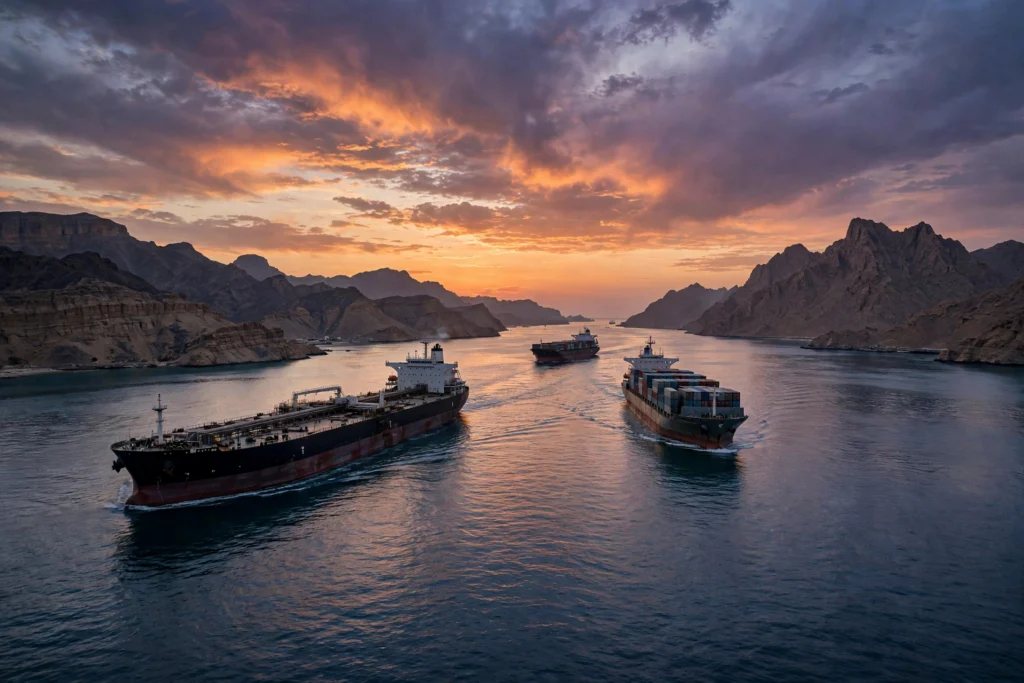
Strait of Hormuz Ship Sinking: Container Vessel Hits Naval Mine and Goes Down, Iran Says
A war is being fought at sea — and on Wednesday it swallowed a ship whole
Imagine steering a cargo ship the length of three football fields through one of the narrowest, most dangerous waterways on Earth — with a war raging around you, mines in the water, and two navies arguing over which route you’re allowed to take. On Wednesday morning, October 14, 2026, one vessel got it wrong. The Strait of Hormuz ship sinking that followed is now sending shockwaves through energy markets, shipping lanes, and a conflict that keeps finding new ways to escalate.
A container ship carrying more than 2,500 containers struck a naval mine in the southern waters of the Strait of Hormuz, caught fire, and went down. Iran’s Revolutionary Guard Corps Navy announced it. Singapore’s maritime authority described a different version of events. And somewhere in between, shipping companies, insurers, and oil traders are all asking the same question: is this waterway still safe to use at all?
What Happened in the Strait of Hormuz on Wednesday
According to a statement from the IRGC Navy’s public relations office, carried by Iranian state media and reported by PressTV, a container ship was attempting to cross the Strait of Hormuz through what Tehran calls “an unauthorized and dangerous route” when it struck a naval mine. The explosion triggered a fire so intense that the vessel sank on Wednesday morning in the southern waters of the strait.
The Guard released images showing a ship tilted in the water, spewing a thick plume of black smoke, with containers floating in the surrounding sea. Its warning to local mariners was blunt: local vessels and fishermen must exercise the utmost safety when navigating this route so they do not collide with containers floating on the water. Thousands of containers from the wreck are now adrift in one of the busiest shipping lanes on the planet.
Iran has repeatedly warned ships against trying to transit the strait without its approval. In its recent statements, the IRGC has said vessels that switch off their navigation and identification systems would be treated as hostile. The unidentified ship’s crew and flag were not disclosed by Iranian officials, and the Associated Press noted it could not independently verify the images Iran released.
Two Stories, One Sunken Ship
Here’s where things get murky. While Iran says a mine did the job, shipping officials tell a different story. Singapore’s Maritime and Port Authority said two Singapore-registered cargo vessels were hit by “unknown projectiles” as they passed through the strait on Tuesday and Wednesday. One of them sank; the other reached safety. All crew members were evacuated from the sunken vessel, and no injuries were reported in either incident.
“Such attacks are unprovoked, unjustifiable, and a breach of international law,” the authority said — language that leaves no doubt about how Singapore views what happened.
British maritime security firm Vanguard identified one of the vessels as the Singapore-flagged GFS Pride, reporting it was hit by a projectile on Tuesday and subsequently sank. The firm also reported three other attacks on vessels in the area the same day: two ships continued their journeys, while the status of a third remained unclear.
So was it a mine or a projectile? It remains unclear whether the Singapore-flagged vessel that sank is the same ship Iran says struck a mine. The UK Maritime Trade Operations center (UKMTO) issued fresh warnings on Wednesday after receiving what it called “verified” reports of container ships being struck by unknown projectiles in separate incidents on Tuesday. What everyone agrees on: a large container ship went to the bottom of the Strait of Hormuz this week, and nobody’s account fully explains how.
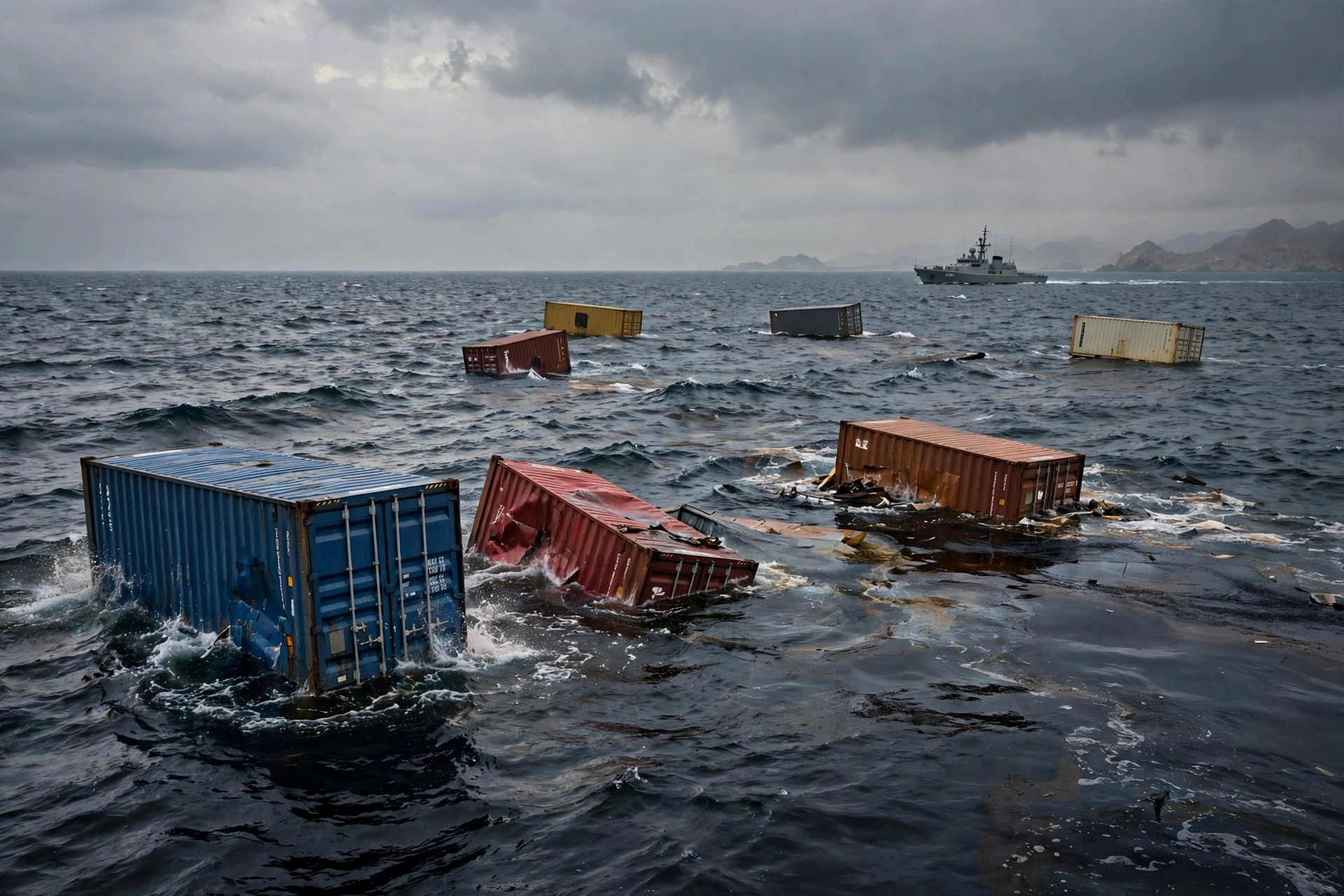
(Illustrative image: containers adrift in the Strait of Hormuz after the sinking — the IRGC has warned local vessels to watch for floating debris.)
A Pattern, Not a One-Off
This week’s disaster didn’t come out of nowhere. According to the IRGC’s own announcements, the Strait of Hormuz has been getting more dangerous by the day:
On Monday, the Guard reported that an oil tanker had struck a naval mine after disregarding warnings and attempting an unauthorized route. That incident followed two similar cases involving oil tankers in the preceding days. And on October 9, the IRGC said its forces had struck a liquefied petroleum gas carrier attempting to pass south of the strait through an unauthorized lane.
The pattern is unmistakable: Tehran is tightening its grip on the waterway, treating routes it hasn’t approved as hostile, and commercial vessels are caught in the middle. Maritime intelligence desk Eagle Intelligence reported six vessels struck near the strait in a single 24-hour stretch — the highest pace of incidents since the current conflict began, with at least one sinking and two crew members missing.
Why the World Can’t Look Away: 19 Million Barrels a Day
Let’s talk about why a single ship sinking in a narrow strait between Iran and Oman has oil traders sweating. Roughly a fifth of the world’s oil passes through the Strait of Hormuz. The U.S. military says 19 million barrels of crude transited the waterway on October 12 alone — a day before the attacks began. Every incident here is a direct threat to global energy supply, and markets price that fear instantly.
This isn’t happening in a vacuum, either. Energy markets have been on edge for weeks — Trump’s announcement of a Russia-Ukraine energy ceasefire was itself an attempt to calm fuel prices. Now, with tankers being struck and a container ship on the seafloor, the question isn’t just whether oil flows — it’s at what price, and who dares to carry it.
Insurers writing war-risk cover for Gulf routes are already recalculating. Charterers and operators now face urgent decisions about routing, crew safety, and whether the Omani-side route the U.S. military has been guiding ships through is protection enough.
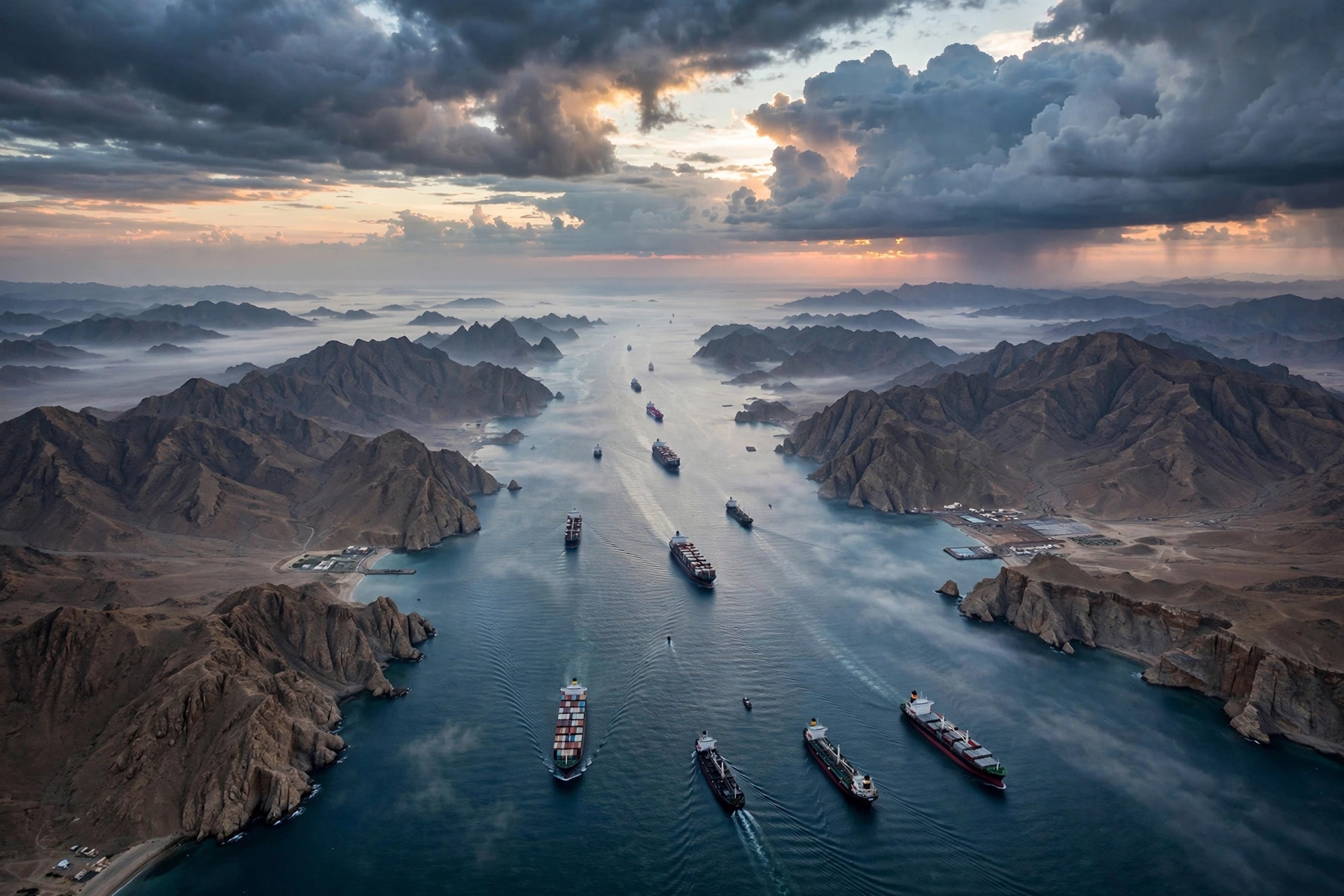
(Illustrative image: the Strait of Hormuz chokepoint — the narrow waterway through which around a fifth of the world’s oil supply travels.)
America’s Response and the Widening Escalation
Washington is not sitting this out. The U.S. military has been guiding ships through the strait along a route nearer to Oman’s coast, away from Iranian-controlled lanes. And the Pentagon is making a show of force: U.S. Central Command released video of an AH-1Z Viper attack helicopter destroying an Iranian wooden merchant boat — which CENTCOM described as a move to disrupt Iran’s trade routes.
Meanwhile, the conflict is spilling far beyond the strait. Iran-backed Houthi forces claimed on Wednesday to have launched ballistic and cruise missiles and drones at targets in or near the Saudi capital Riyadh — including King Khalid International Airport and an Aramco refinery — as well as an Aramco facility in Dammam. Saudi-backed Yemeni coalition forces said they intercepted a ballistic missile headed for Riyadh, though debris from interceptions injured four people and damaged homes. According to the AND Magazine morning brief, the Houthi strike on an administrative building at Saudi Aramco’s headquarters complex in Dhahran caused more extensive damage than first described, with fire spreading across multiple floors.
Tehran, for its part, is digging in. The Iranian Army’s Navy announced it is deploying operational units “in a new formation east of the Strait of Hormuz and across the Sea of Oman and the Arabian Sea,” tasked with real-time surveillance of enemy activity. And a top Iranian official said Iran must be prepared for war even as it negotiates with the United States — a sentence that tells you everything about how fragile the current pause really is.
The Human Cost at Sea
Amid the geopolitics, it’s worth pausing on the people. The crew of the sunken Singapore-flagged vessel was evacuated with no injuries reported — a small mercy in a week that could easily have produced a mass-casualty disaster at sea. Two crew members from other struck vessels are reportedly missing, a reminder that behind every “maritime incident” are sailors doing an ordinary job in extraordinary danger.
The Strait of Hormuz has always been unforgiving, and this week it claimed another vessel — just days after the Djibouti boat tragedy reminded the world how deadly these waters can be when things go wrong. Whether by mine or missile, the sea doesn’t care about the politics. It takes ships all the same.
FAQ: The Strait of Hormuz Ship Sinking
What ship sank in the Strait of Hormuz?
Iran’s IRGC Navy says a container ship carrying more than 2,500 containers sank on Wednesday morning, October 14, 2026, after striking a naval mine on what Tehran called an unauthorized route. Singapore’s maritime authority separately reported a Singapore-registered cargo vessel sank after being hit by “unknown projectiles.” It is unclear whether these are the same ship.
Was anyone killed in the sinking?
No deaths have been reported from the sunken container ship — Singapore’s authority says all crew were evacuated with no injuries. However, maritime intelligence reports indicate two crew members from other vessels struck in the area this week are missing.
Why is the Strait of Hormuz so important?
The strait is the world’s most critical oil chokepoint, carrying roughly a fifth of global oil supply. About 19 million barrels of crude passed through it on October 12 alone, according to the U.S. military. Any disruption threatens global energy prices.
Who is responsible for the attacks?
That depends on whose account you believe. Iran says the ship struck a mine on an unauthorized route and has warned vessels against ignoring its navigation restrictions. Singapore calls the attacks “unprovoked” and “unjustifiable.” Independent verification of Iran’s claims remains limited, and the UKMTO has issued warnings about projectile and mine strikes in the area.
The Bottom Line
A container ship lies on the seafloor of the Strait of Hormuz, 2,500 containers are floating in the world’s most important oil lane, and two competing stories — a mine, or a missile — can’t both be true. What is true is that the waterway is more dangerous than it has been at any point in this conflict, with six vessels struck in 24 hours and navies on both sides hardening their positions.
The U.S. says oil is still flowing. Iran says unauthorized routes are hostile. The Houthis are striking Saudi oil infrastructure hundreds of miles away. And a top Iranian official is talking about preparing for war while negotiating peace. If this is what a “pause” in the conflict looks like, nobody should feel reassured.
Watch what happens next: whether the UKMTO or CENTCOM confirm the sinking, whether insurers pull back from Gulf routes, and whether the next ship that takes a wrong turn in the strait brings its crew home. The Strait of Hormuz has always been a chokepoint. This week, it became a graveyard.
Pingback: US Inflation Jumps to 3.7% in September — Wall Street Slides as Fed Rate-Hike Bets Surge - Storion News
Pingback: Air India Flight AI2030 Diverted to Jaipur After Hijack Code 7500 Alert — DGCA Probes False Alarm - Storion News
Pingback: Niger China Oil Ultimatum: Niamey Gives Chinese Giants 45 Days to Return $5.2 Billion - Storion News