
Meta’s Muse Spark Open: The 816B-Parameter AI Model You Can Download — If You Own Two $10,000 Macs
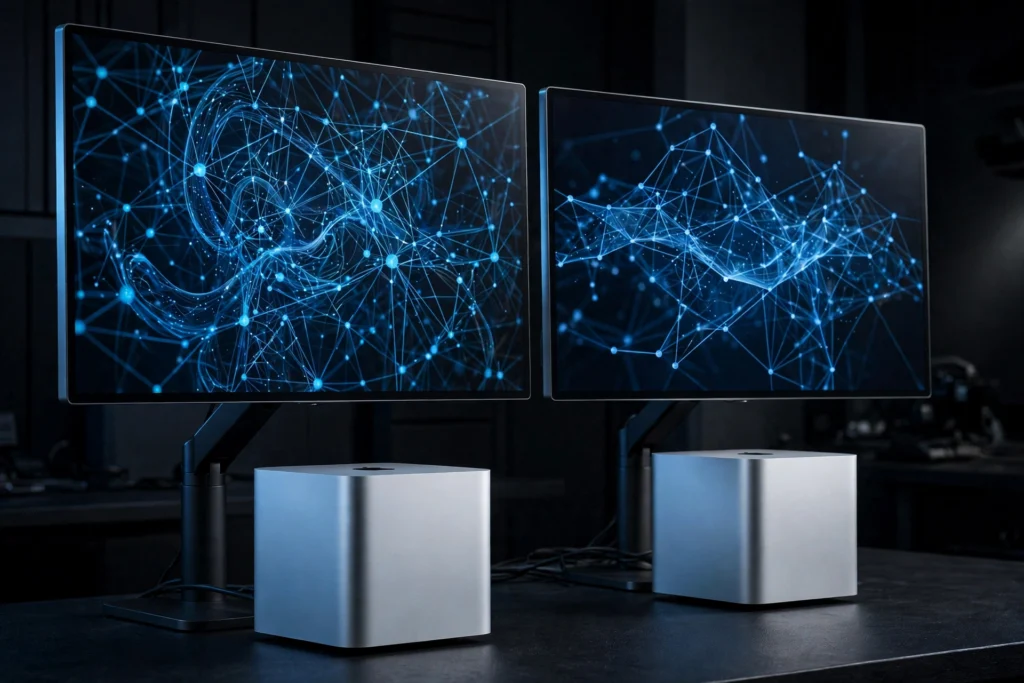
Here’s a deal that sounds too good to be true: Meta will give you, completely free of charge, the weights of the largest open-weight AI model any American lab has ever released. The catch? Actually running Muse Spark Open requires roughly a terabyte of RAM — which is why Meta suggests you park two Apple Mac Studios on your desk to get it going. That setup would cost you well north of $20,000.
Welcome to the strange, fascinating new era of “open” AI, where the models are free but the electricity bill is not.
Meta’s Meta Superintelligence Labs launched Muse Spark Open on October 15, 2026, and it immediately became the biggest story in the AI world. Here’s everything you need to know about it — what it is, what it can do, and whether it actually changes anything.
What exactly is Muse Spark Open?
At its core, Muse Spark Open is a monster of a language model: 816 billion total parameters built on a mixture-of-experts architecture. That means not all 816 billion parameters fire at once — for every word it generates, only about 42 billion parameters actually switch on, routed through 256 specialist “experts,” eight of which handle each token. Think of it less like one giant brain and more like a hospital with 256 specialists, where only the eight relevant ones are paged for each patient.
The headline specs are genuinely eye-popping:
- 816 billion parameters — the largest open-weight release from a US lab to date
- 1 million token context window (1,048,576 tokens, to be exact) — enough to swallow entire codebases in one prompt
- Natively multimodal — it reads text, images, audio, and video, and writes text
- Built for agentic work — long, multi-step tasks where the AI uses tools and works semi-independently
Meta’s chief of AI, Alexandr Wang, didn’t mince words, calling it “the most capable US open-weight model to date.” The model is derived from Muse Spark 1.2, which shipped in August, with extra safety post-training so it behaves itself even outside Meta’s own guardrails.
The Mac twist nobody saw coming
The most surprising part of the announcement wasn’t the size. It was the hardware Meta chose to demo it on: Apple Mac Studios.

Using Apple’s MLX framework, Meta linked two M5 Ultra Mac Studios together — pooling about a terabyte of unified memory — and ran the model on what it called “one supercomputer.” Apple’s own documentation clocks the compressed 4-bit version at about 25 tokens per second across two machines, rising to roughly 37 tokens per second with four, using Thunderbolt 5 cables to shuttle data between units at low latency.
Meta CEO Mark Zuckerberg even publicly thanked Apple’s John Ternus for the collaboration. Wang told Axios the partnership meant “mommy and daddy are playing nice again,” according to reports — a reference to the two tech giants’ famously frosty relationship over the years.
Of course, there’s fine print. The 512GB Mac Studio configuration Meta recommends isn’t even shipping yet — it’s expected later this month — and even the 256GB version costs over $10,000. Two of the maxed-out models, plus tax? You’re looking at a small car’s worth of hardware.
So what can it actually do?
Muse Spark Open is aimed squarely at one job: coding and long-running agent work. And Meta’s demos suggest it’s genuinely impressive at it.
Paired with Muse Code, Meta’s AI coding terminal, the model worked through real bug fixes and new features for Ice Cubes, the open-source Mastodon client — multi-file refactors and long debugging sessions, the kind of tedious developer work that eats entire afternoons. Meta also tested it far outside the data center: it reviewed footage in DaVinci Resolve, the high-end video editing software, frame by frame, picking out and cropping the best shots for vertical video.
The benchmarks tell an interesting story. On JobBench, an agent benchmark, Muse Spark Open scored 61.8 — more than double the 31.1 recorded by Inkling, the open model from Thinking Machines Lab, and well ahead of Nvidia’s Nemotron 3 Ultra at 27.2. That’s a serious lead in agentic tool use.
But there’s a wrinkle: Chinese open models still beat it at pure coding. On Terminal-Bench 2.1, Muse Spark Open scored 76.4 — behind Kimi K3 (85.0), GLM 5.3 (83.9), and Qwen3.8 (82.0). The race for open AI supremacy is increasingly a US-versus-China contest, and it comes at a moment when China is tightening its grip on AI and tech exports, turning every model release into a geopolitical statement.
Open — but not quite open source
This is where the story gets complicated. “Open-weight” means Meta is giving developers the trained model’s weights to download, modify, and host wherever they like — a huge deal for companies that want to build internal AI tools while controlling where their data goes. It is not the same as open source.
Muse Spark Open ships under Meta’s Muse Model License, which comes with limited commercial terms. Developers should read the fine print before treating it as unrestricted software — you can’t recreate Meta’s training process from this, and some commercial uses are restricted. As one guide put it, downloading the weights is not the same as getting everything needed to rebuild the model from scratch.
For most developers, the practical route isn’t a $20,000 Mac setup anyway — it’s the cloud. The weights are available on Hugging Face, Amazon SageMaker AI, Google Cloud Model Garden, and Microsoft Foundry Models, and hosted APIs launched on day one from Together AI, Baseten, Fireworks AI, Groq, Modal, Nebius, and OpenRouter.
Why it matters
Here’s the bigger picture. The AI industry is splitting in two. On one side, closed frontier models — Meta launched its closed flagship Muse Wonder just three days before this release — that you can only use through a company’s chatbot or API. On the other, open-weight models that developers can download and run (almost) anywhere.
Open-weight releases matter because they decentralize power. A company building an internal coding assistant could host Muse Spark Open on its own infrastructure, keeping sensitive code in-house instead of sending it to a third party. Researchers can probe how it behaves more directly. Smaller cloud providers can compete to host it. And in a year when AI startups are collapsing under compute costs, a free-to-download frontier-class model is a lifeline for anyone who can’t afford to train their own.
It also throws fuel on the chip boom powering AI’s insatiable hardware appetite — every 816-billion-parameter download is a reminder that the memory and GPU crunch isn’t ending anytime soon.
FAQ: Muse Spark Open
What is Muse Spark Open?
It’s an 816-billion-parameter open-weight AI model released by Meta on October 15, 2026. Meta calls it the most capable US open-weight model to date, and it’s designed for coding and long-horizon agentic work with a 1-million-token context window.
Can I run Muse Spark Open on my laptop?
Almost certainly not. The full-precision version needs about 1.6TB of storage, and running it locally requires roughly 1TB of RAM — Meta’s own demo used two linked Mac Studios. Community-built compressed versions (as small as ~300GB) could eventually run on high-end workstations, but your MacBook Air won’t cut it.
Is Muse Spark Open really free?
The weights are free to download, but the Muse Model License includes limited commercial terms — it’s open-weight, not unrestricted open source. Most developers will use it through hosted APIs, where providers charge for compute.
How does it compare to other open models?
It’s the largest US open-weight release and leads in agentic benchmarks (JobBench 61.8 vs. 31.1 for Thinking Machines Lab’s Inkling). But Chinese models — Kimi K3, GLM 5.3, Qwen3.8 — currently beat it on coding benchmarks, so the open-model crown is still contested.
The bottom line
Muse Spark Open is the most significant open-weight AI release of 2026 — a genuine frontier-class model that anyone can download, inspect, and build on. That you need a small fortune in hardware to run it locally is beside the point; the real story is that Meta keeps pushing powerful models into the open while the closed frontier keeps racing ahead. The AI war isn’t just about who builds the smartest model anymore. It’s about who gets to run it — and where.