

7.0-Magnitude Tibet Earthquake Kills 16 Near Nagqu as Rescuers Battle Cold and Snow
A Mountain Town Rocked at Night
Picture this: it’s nearly 10:35 at night in one of the highest, most remote places on Earth, and the ground suddenly starts tearing itself apart. That’s what happened to the people of Nagqu, Tibet, late Thursday night, when a 7.0-magnitude earthquake ripped through the region — killing at least 16 people, injuring dozens more, and flattening 339 homes in a matter of seconds.
The Tibet earthquake struck at 10:33 p.m. local time on October 22, with its epicenter about 191 kilometers east-northeast of Nagqu city, in Baqên County of northern Tibet — a sparsely populated, high-altitude area roughly 400 kilometers from the capital, Lhasa. The U.S. Geological Survey (USGS) measured the quake’s depth at about 18 kilometers, shallow enough to make the shaking at the surface brutally destructive.
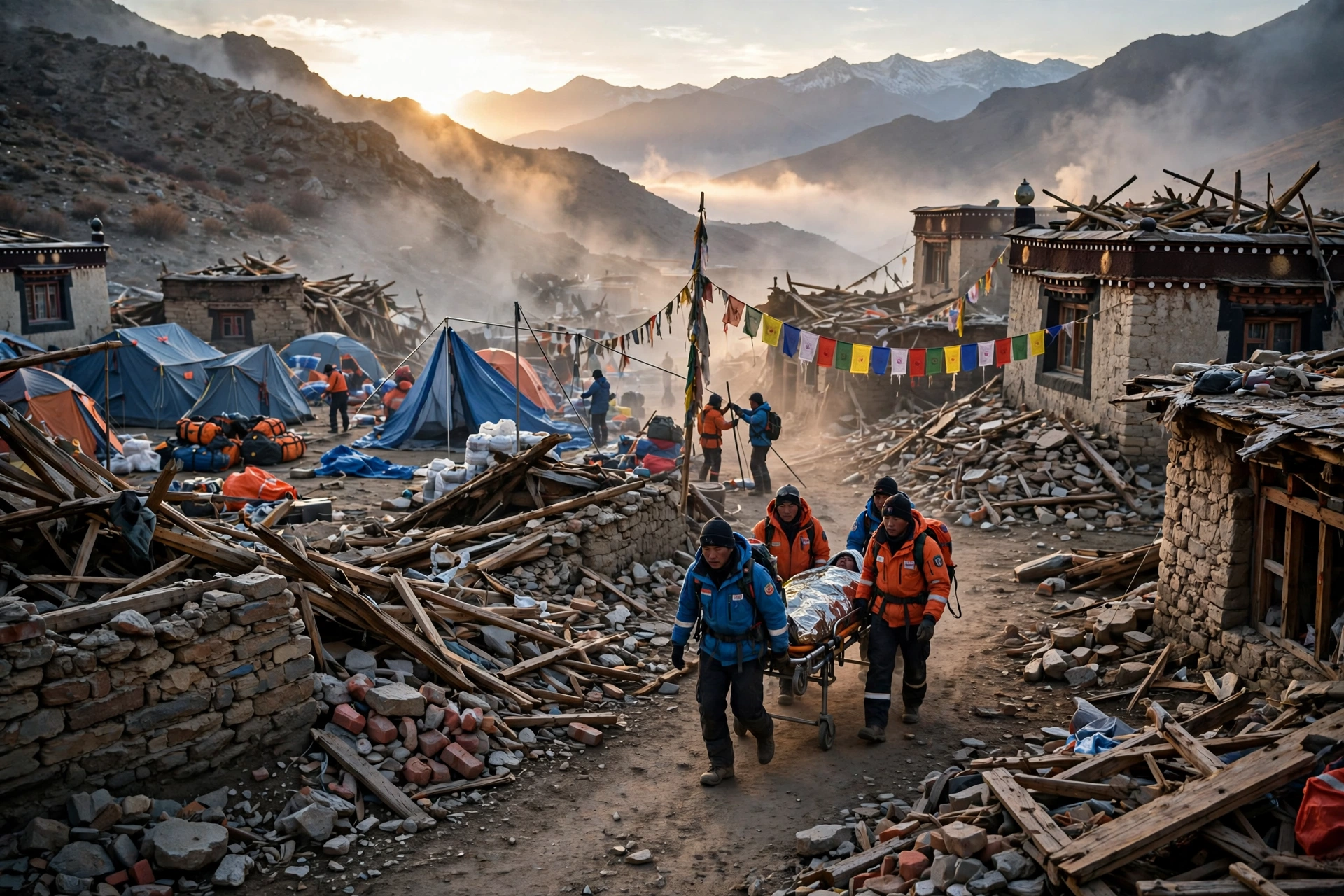
Residents rushed out of their homes into the freezing night. Chinese state media footage showed people gathering outdoors and sheltering in vehicles as aftershocks kept the ground restless. Power lines went down, roads cracked open, and entire rows of houses crumbled into dust.
The Rescue Race Against Time
When disaster hits the Tibetan Plateau, the biggest enemy isn’t just the rubble — it’s the altitude, the cold, and the sheer remoteness of it all. More than 1,600 rescue personnel have been deployed to the quake zone, according to reports citing local authorities, including over 300 police officers and 347 fire and rescue personnel.
Authorities dispatched emergency supplies in waves: 1,000 prefabricated housing units, 3,000 tents, folding beds, flashlights, and warm clothing for families suddenly left homeless in a region where nighttime temperatures are already punishing in late October. The forecast isn’t helping either — intermittent snowfall over the coming days could slow rescue teams and complicate recovery for the displaced.
As of Friday morning, officials confirmed 16 dead while Reuters reported the injury count had risen to 65, up from the 32 initially reported — with 11 of the injured in serious condition. More than 12,000 people have been relocated to safety, state media outlet Xinhua reported. The numbers could still move as teams reach the most isolated villages. The full damage is still being assessed — beyond the 339 collapsed homes, at least 20 livestock sheds were destroyed, a real blow for herding families whose animals are their livelihood.
Transportation Cut Off
The quake didn’t just destroy homes — it severed the lifelines the region depends on. Railway authorities suspended train services through the quake-hit zones, Chinese state broadcaster CCTV reported. Sections of National Highway 317 were closed after rockfalls buried parts of the road, and access in the affected areas is now restricted to emergency and rescue vehicles only.
Strong tremors were felt well beyond the epicenter — in the Tibetan cities of Qamdo and Nyingchi — reminding millions across the plateau just how far the energy from a 7.0 quake can travel. Power supply in parts of the region was disrupted, adding darkness to an already harrowing night for survivors.
Why Tibet Shakes So Often
If you’re wondering why Tibet keeps making earthquake headlines, the answer lies literally beneath the feet of everyone on the plateau. Tibet sits on the Tibetan Plateau, where the Indian tectonic plate is still grinding into the Eurasian plate — the same collision that built the Himalayas millions of years ago and keeps pushing them upward today. That slow-motion continental crash makes the region one of the most seismically active places on the planet.

This isn’t the region’s first recent shock. Just last month, on September 3, a magnitude 5.0 earthquake struck Tibet at a depth of roughly 14 kilometers. And the memory of January 2025 is still raw: a 6.8-magnitude quake then killed more than 120 people and injured hundreds. Back in 2023, a magnitude 6.2 earthquake in the neighboring Gansu province killed over 120 as well. Each quake is a reminder of how exposed high-altitude communities are when the earth moves.
The pattern feels familiar to disaster watchers. Earlier this month we covered a 6.9-magnitude earthquake off Russia’s Kamchatka Peninsula that, mercifully, triggered no tsunami — and earlier this year a magnitude 7.7 earthquake shook Panama. The planet has been unusually restless this year, and scientists are watching aftershock patterns on the plateau closely.
China’s Disaster Response Under the Spotlight
China has a well-drilled emergency response playbook for earthquakes in remote regions — and the speed of the deployment here shows it. Prefabricated housing units and tents rolling in within hours suggest the lesson of past disasters has been absorbed: on the plateau, exposure kills faster than rubble does.
But there will be questions. Why did so many buildings collapse in a region that has seen repeated strong quakes? Rural homes in remote Tibet are often built with traditional materials and minimal seismic reinforcement — cheap to build, catastrophic when the ground moves. Rebuilding with proper earthquake-resistant construction will be the real test in the months ahead.
It’s also worth noting the strain on the system. China’s economy is navigating a property slump and uneven export picture, and the cost of another major disaster recovery — homes, roads, railways, livelihoods — won’t be small. Relief work is underway; recovery will be measured in years.
FAQs: What We Know So Far
How strong was the Tibet earthquake?
The earthquake measured magnitude 7.0, according to the USGS and Chinese authorities. It struck at 10:33 p.m. local time on Thursday, October 22, with its epicenter near Baqên County in northern Tibet, about 191 kilometers from Nagqu city. India’s National Centre for Seismology placed the epicenter at latitude 32.368 N and longitude 93.853 E.
How many people were killed or injured?
As of the latest official figures, at least 16 people have died and 65 are injured — 11 of them in serious condition — according to a Friday report from Reuters citing the local government. The numbers could still change as rescue teams reach remote areas.
How bad is the damage?
At least 339 homes and 20 livestock sheds collapsed. Power supply is disrupted in parts of the region, rail services are suspended through quake-hit zones, and sections of National Highway 317 are closed due to rockfalls. Over 1,600 rescue personnel and large consignments of tents, prefabricated housing, and warm clothing have been deployed.
Could there be more quakes?
Aftershocks are almost guaranteed after a 7.0 earthquake — they typically follow for days or weeks, some strong enough to topple already-damaged buildings. Whether a larger quake follows is not predictable with current science, but seismologists will be monitoring the region’s fault systems closely.
The Bottom Line
Sixteen people went to sleep on Thursday night and never woke up. Hundreds of families are now living in tents on the roof of the world, with snow in the forecast. The rescue machinery is moving fast — 1,600 personnel, thousands of tents, emergency housing — and that speed will save lives. But the deeper story is the one Tibet keeps telling: the ground here will keep shaking, and the real question is whether the buildings people live in are ready when it does. For now, the priority is simple and urgent — find the missing, shelter the survivors, and don’t let the cold do what the quake started.